I remember the first time I zoomed out on Google Earth and looked at our planet from space. Everything looked calm. Blue oceans, brown deserts, green forests, white clouds. Earth looked like a perfect, peaceful ball.
/wp:paragraph wp:paragraphThen I zoomed back in.
/wp:paragraph wp:paragraphMountains appeared. Ocean trenches appeared. Volcanoes appeared. Long cracks and fault lines started showing up. Places like Japan, Chile, Iceland, California, and the Himalayas suddenly did not feel random anymore. They looked connected to something deeper.
/wp:paragraph wp:paragraphThat was when Earth stopped feeling like a still object to me.
/wp:paragraph wp:paragraphThe ground under our feet feels solid, but it is part of a thin, moving, rocky layer called Earth’s crust. We walk on it, build homes on it, grow food from it, mine materials from it, and sometimes feel it shake during earthquakes.
/wp:paragraph wp:paragraphEarth’s crust is not just “land.” It is the surface of a living planet.
/wp:paragraph wp:paragraphIf you enjoy beginner-friendly science facts like this, you may also like Sanceen’s guide on 25 Space Facts That Reveal How Strange the Universe Really Is, because Earth becomes even more interesting when you compare it with the wider universe.
/wp:paragraph wp:headingQuick Answer: What Is Earth’s Crust?
/wp:heading wp:paragraphEarth’s crust is the thin, solid, rocky outer layer of our planet. It sits above the mantle and forms the surface where humans, animals, plants, oceans, mountains, and cities exist.
/wp:paragraph wp:paragraphA simple way to imagine it:
/wp:paragraph wp:paragraphIf Earth were an apple, the crust would be like the apple skin.
/wp:paragraph wp:paragraphThat sounds small, but this “skin” controls a huge part of life on Earth. It holds our soil, rocks, minerals, fossils, mountains, ocean floors, and many natural hazards.
/wp:paragraph wp:paragraphAccording to National Geographic Education’s guide to Earth’s crust, the crust is Earth’s outermost layer and is made of solid rocks and minerals. It is also the only place in the known universe where life has been confirmed.
/wp:paragraph wp:headingKey Facts About Earth’s Crust
/wp:heading wp:table| Fact | Simple Explanation |
|---|---|
| Earth’s crust is the outermost layer | It is the rocky surface layer we live on. |
| It is very thin compared with Earth | The crust is tiny compared with the mantle and core. |
| There are two main types | Continental crust and oceanic crust. |
| Continental crust is thicker | It forms the continents and is usually lighter. |
| Oceanic crust is thinner | It lies under oceans and is usually denser. |
| The crust is broken into plates | These plates move slowly over time. |
| Plate movement causes earthquakes | Stress builds when plates push, pull, or slide. |
| Volcanoes often form near plate boundaries | Magma can rise where crust is pulled apart or pushed down. |
| The crust contains rocks and minerals | These materials support buildings, tools, electronics, and roads. |
| The crust stores Earth’s history | Fossils and ancient rocks reveal past life and old environments. |
1. Earth’s Crust Is Much Thinner Than People Imagine
/wp:heading wp:paragraphOne of the most surprising facts about Earth’s crust is how thin it is.
/wp:paragraph wp:paragraphWhen you stand on the ground, it feels endless. A mountain feels huge. A canyon feels deep. A mine feels extremely far below the surface.
/wp:paragraph wp:paragraphBut compared with the full size of Earth, the crust is only a thin outer shell.
/wp:paragraph wp:paragraphThis is why the apple-skin example works so well. The crust feels massive to us because we live on it, but compared with the whole planet, it is extremely small.
/wp:paragraph wp:paragraphThat fact changed the way I look at landscapes.
/wp:paragraph wp:paragraphA mountain may look massive from the road, but on a planet-sized scale, it is more like a wrinkle. A deep canyon may feel enormous, but compared with Earth’s full depth, it is only a scratch.
/wp:paragraph wp:paragraphAnd still, this thin crust creates some of the most dramatic places on Earth: the Himalayas, the Andes, the Grand Canyon, volcanic islands, ocean trenches, and deep valleys.
/wp:paragraph wp:image {“id”:700}
2. There Are Two Main Types of Earth’s Crust
/wp:heading wp:paragraphA common mistake is thinking Earth’s crust is the same everywhere.
/wp:paragraph wp:paragraphIt is not.
/wp:paragraph wp:paragraphEarth has two main types of crust:
/wp:paragraph wp:heading {“level”:3}Continental crust
/wp:heading wp:paragraphThis is the crust under continents and large landmasses.
/wp:paragraph wp:heading {“level”:3}Oceanic crust
/wp:heading wp:paragraphThis is the crust under ocean floors.
/wp:paragraph wp:paragraphThe two are different in thickness, density, age, and composition.
/wp:paragraph wp:paragraphContinental crust is usually thicker and less dense. Oceanic crust is usually thinner and denser. National Geographic explains that oceanic crust is mostly basaltic, while continental crust is mainly made of granite-like rocks. You can read the full explanation in National Geographic Education’s crust resource.
/wp:paragraph wp:paragraphA simple way to picture it:
/wp:paragraph wp:paragraphThink of continental crust like a thick but lighter piece of foam. Think of oceanic crust like a thinner but heavier tile.
/wp:paragraph wp:paragraphThat is one reason continents sit higher and ocean basins sit lower.
/wp:paragraph wp:heading3. Continental Crust Is Old, Thick, and Complicated
/wp:heading wp:paragraphContinental crust is the crust under places like Asia, Africa, Europe, North America, South America, Australia, and Antarctica.
/wp:paragraph wp:paragraphIt is not one smooth piece of rock. It is a messy, ancient mixture of mountains, old volcanoes, buried sediments, folded rocks, minerals, basins, and deep crustal roots.
/wp:paragraph wp:paragraphSome parts of continental crust are extremely old. That is why geologists can learn so much from rocks.
/wp:paragraph wp:paragraphA rock is not just a rock. It can be a record of an ancient ocean, an old mountain range, a volcanic eruption, a desert, a glacier, or even a lost continent.
/wp:paragraph wp:paragraphWhen you see layered rocks in a cliff, those layers may have formed from sand, mud, shells, volcanic ash, or river deposits millions of years ago.
/wp:paragraph wp:paragraphThe crust keeps receipts.
/wp:paragraph wp:paragraphIt stores pressure, heat, movement, erosion, and time.
/wp:paragraph wp:paragraphIf you like reading about how scientists study planetary surfaces, Sanceen also has a simple article on How NASA Maps the Surface of Mars. Mars does not have Earth-style active plate tectonics today, but mapping its surface helps scientists compare rocky planets in a fascinating way.
/wp:paragraph wp:heading4. Oceanic Crust Is Younger, Thinner, and Denser
/wp:heading wp:paragraphOceanic crust sits under ocean floors.
/wp:paragraph wp:paragraphIt is usually thinner than continental crust, but it is denser. It is mostly basaltic, meaning it contains more minerals rich in iron and magnesium.
/wp:paragraph wp:paragraphOne of the coolest facts about oceanic crust is that it is constantly being created and destroyed.
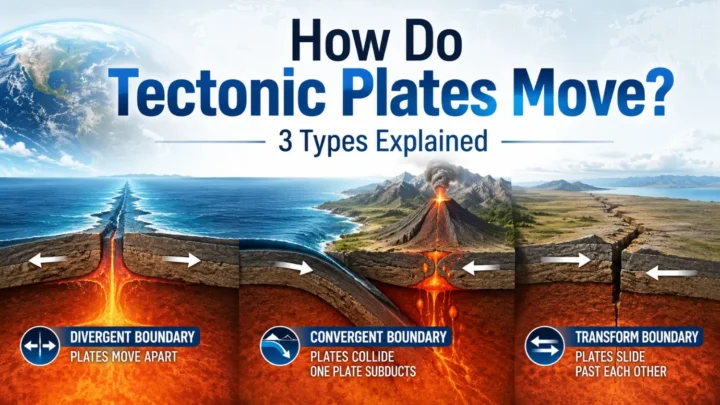
/wp:paragraph wp:paragraphNew oceanic crust forms at mid-ocean ridges, where tectonic plates move apart and magma rises from below. That magma cools and becomes new rock. Older oceanic crust can later sink back into the mantle at subduction zones.
/wp:paragraph wp:paragraphThis surprised me when I first learned it.
/wp:paragraph wp:paragraphI used to think ocean floors must be the oldest parts of Earth because oceans feel ancient. But many ocean floors are younger than the oldest rocks on continents.
/wp:paragraph wp:paragraphThe ocean may look timeless, but the crust under it is always being renewed.
/wp:paragraph wp:image {“id”:701}
5. Earth’s Crust Is Broken Into Moving Plates
/wp:heading wp:paragraphEarth’s crust is not one complete shell.
/wp:paragraph wp:paragraphIt is broken into huge pieces called tectonic plates. These plates move slowly over time.
/wp:paragraph wp:paragraphNOAA explains that Earth’s crust, or lithosphere, consists of 15 to 20 moving tectonic plates. The plates fit together like pieces of a cracked shell and move because of heat inside the planet. You can read NOAA’s explanation here: What Is Tectonic Shift?.
/wp:paragraph wp:paragraphThat sounds slow and boring at first.
/wp:paragraph wp:paragraphBut over millions of years, tiny movement becomes huge change.
/wp:paragraph wp:paragraphA few centimeters per year can move continents, open oceans, build mountains, and close ancient seas.
/wp:paragraph wp:paragraphThis is one of the most important facts about Earth’s crust:
/wp:paragraph wp:paragraphThe crust is solid, but it is not fixed.
/wp:paragraph wp:paragraphIt moves.
/wp:paragraph wp:heading6. Earthquakes Show That the Crust Is Active
/wp:heading wp:paragraphEarthquakes are one of the clearest signs that Earth’s crust is not still.
/wp:paragraph wp:paragraphTectonic plates move slowly, but their edges can get stuck. Stress builds up. When the rocks finally slip, energy is released as seismic waves. That shaking is what we feel as an earthquake.
/wp:paragraph wp:paragraphA simple way to imagine it:
/wp:paragraph wp:paragraphPush two rough bricks against each other and try to slide them. They do not move smoothly. They stick, grind, and suddenly jump.
/wp:paragraph wp:paragraphThe crust behaves somewhat like that along faults.
/wp:paragraph wp:paragraphNOAA notes that where tectonic plates meet, crustal rocks can grind against each other, causing earthquakes and volcanic eruptions.
/wp:paragraph wp:paragraphOne practical way to see this is by opening the official USGS Latest Earthquakes Map. This tool shows recent earthquakes on an interactive map and is one of the easiest ways to see that earthquakes often cluster near active faults and plate boundaries.
/wp:paragraph wp:image {“id”:702}
7. Volcanoes Are Connected to Crust Movement
/wp:heading wp:paragraphVolcanoes are not just random mountains with lava inside.
/wp:paragraph wp:paragraphThey are surface signs of deeper activity involving the crust, mantle, magma, and tectonic plates.
/wp:paragraph wp:paragraphMany volcanoes form near plate boundaries. Some form where plates move apart. Others form where one plate sinks below another. Some form over hot spots.
/wp:paragraph wp:paragraphOne famous example is the Pacific Ring of Fire.
/wp:paragraph wp:paragraphNOAA Ocean Exploration describes the Ring of Fire as a string of volcanoes and earthquake sites around the edges of the Pacific Ocean. It includes more than 450 volcanoes and stretches for nearly 40,250 kilometers. You can read NOAA’s full explanation here: What Is the Ring of Fire?.
/wp:paragraph wp:paragraphThat is why places around the Pacific — like Japan, Indonesia, Chile, Alaska, New Zealand, and the western coast of the Americas — are known for earthquakes and volcanoes.
/wp:paragraph wp:paragraphThe crust there is geologically busy.
/wp:paragraph wp:paragraphNot every day in a dramatic movie-style way, but over time, it is very active.
/wp:paragraph wp:image {“id”:703}
8. The Crust Contains Three Major Rock Types
/wp:heading wp:paragraphEarth’s crust is made of rocks and minerals, but not all rocks form the same way.
/wp:paragraph wp:paragraphThe three major rock types are:
/wp:paragraph wp:heading {“level”:3}Igneous rocks
/wp:heading wp:paragraphThese form when melted rock cools and becomes solid.
/wp:paragraph wp:paragraphExamples include:
/wp:paragraph wp:list- Granite
- Basalt
- Obsidian
- Pumice
Basalt is common in oceanic crust. Granite-like rocks are common in continental crust.
/wp:paragraph wp:heading {“level”:3}Sedimentary rocks
/wp:heading wp:paragraphThese form when pieces of rock, shells, minerals, or organic material build up and harden over time.
/wp:paragraph wp:paragraphExamples include:
/wp:paragraph wp:list- Sandstone
- Limestone
- Shale
Sedimentary rocks are important because they often preserve fossils.
/wp:paragraph wp:heading {“level”:3}Metamorphic rocks
/wp:heading wp:paragraphThese are rocks changed by heat, pressure, or chemical activity.
/wp:paragraph wp:paragraphExamples include:
/wp:paragraph wp:list- Marble
- Slate
- Gneiss
If you have ever seen marble flooring or a marble countertop, you have seen a rock that was changed deep inside Earth’s crust.
/wp:paragraph wp:paragraphThe National Park Service has a useful beginner-friendly resource on rocks and minerals, which is helpful for understanding how rocks connect to landscapes, parks, and everyday materials.
/wp:paragraph wp:image {“id”:704}
9. Soil Comes From the Crust
/wp:heading wp:paragraphMost people think of soil as just dirt.
/wp:paragraph wp:paragraphBut soil is one of the most valuable things Earth’s crust gives us.
/wp:paragraph wp:paragraphSoil forms when rocks break down over time and mix with organic matter, water, air, and living organisms.
/wp:paragraph wp:paragraphThis process is slow.
/wp:paragraph wp:paragraphVery slow.
/wp:paragraph wp:paragraphHealthy soil can take hundreds or thousands of years to form, depending on climate, rock type, slope, plants, and weathering.
/wp:paragraph wp:paragraphThis is where Earth’s crust becomes personal.
/wp:paragraph wp:paragraphThe food we eat depends on soil. Soil depends on weathered rock. Weathered rock comes from the crust.
/wp:paragraph wp:paragraphSo when we say humans live on Earth’s crust, we are not just talking about standing on rock. We are talking about agriculture, food, forests, rivers, and ecosystems.
/wp:paragraph wp:paragraphA simple real-life observation:
/wp:paragraph wp:paragraphAfter heavy rain, look at muddy water flowing along a roadside or field. That is soil erosion. Tiny pieces of Earth’s crust are being carried away.
/wp:paragraph wp:paragraphIt may look small, but over time, erosion changes landscapes.
/wp:paragraph wp:paragraphFor more simple planet-related explainers, you can explore Sanceen’s Science Facts section.
/wp:paragraph wp:heading10. Earth’s Crust Stores Ancient History
/wp:heading wp:paragraphThe crust is also Earth’s archive.
/wp:paragraph wp:paragraphSedimentary rocks can preserve fossils, footprints, shells, leaves, bones, pollen, and tiny signs of ancient life.
/wp:paragraph wp:paragraphSome rocks show that a desert was once an ocean. Some rocks reveal ancient rivers. Some preserve volcanic ash. Some contain minerals that help scientists understand what Earth was like billions of years ago.
/wp:paragraph wp:paragraphThe Smithsonian has reported on ancient zircon minerals from Western Australia that helped researchers study early plate tectonics, with some zircon crystals dating to around 4.3 billion years old. You can read the Smithsonian report here: Earth’s Oldest Minerals Date Onset of Plate Tectonics.
/wp:paragraph wp:paragraphThat is why rocks matter.
/wp:paragraph wp:paragraphThey are not just hard objects on the ground
/wp:paragraph wp:paragraphThey are clues.
/wp:paragraph wp:paragraphA cliff can be a timeline.
A canyon can be a history book.
A fossil can be a message from a lost world.
11. The Crust Gives Us Materials for Modern Life
/wp:heading wp:paragraphEarth’s crust is also the source of many materials we use every day.
/wp:paragraph wp:paragraphYour phone, laptop, house, road, window, car, and electric wires all connect back to rocks and minerals.
/wp:paragraph wp:paragraphThe crust gives us:
/wp:paragraph wp:list- Iron ore for steel
- Copper for wires
- Silicon for glass and electronics
- Limestone for cement
- Clay for bricks and ceramics
- Aluminum ore for aircraft and cans
- Rare earth elements for modern devices
- Sand and gravel for construction
The Smithsonian National Museum of Natural History explains that minerals are important building blocks for understanding rocks, Earth materials, and natural history. You can read their educational resource here: Gems and Minerals: Beauties and Building Blocks.
/wp:paragraph wp:paragraphThis is where geology connects with technology.
/wp:paragraph wp:paragraphWe often talk about AI, smartphones, satellites, electric cars, and future technology. But behind all of that is the physical world.
/wp:paragraph wp:paragraphNo crust means no minerals.
No minerals means no chips, wires, batteries, buildings, satellites, or solar panels.
Of course, mining needs careful management because it can affect water, land, ecosystems, and communities. But it is still true that modern life depends heavily on materials from Earth’s crust.
/wp:paragraph wp:paragraphYou can also explore Sanceen’s Future Technology section to see how modern technology often depends on materials from the natural world.
/wp:paragraph wp:heading12. Mountains Are Built by Crust Movement
/wp:heading wp:paragraphMountains look permanent to us.
/wp:paragraph wp:paragraphBut in geological time, mountains are always changing.
/wp:paragraph wp:paragraphMany mountain ranges form when pieces of Earth’s crust collide, fold, break, and rise.
/wp:paragraph wp:paragraphThe Himalayas are a famous example. They formed because the Indian Plate collided with the Eurasian Plate. That collision is still happening slowly today.
/wp:paragraph wp:paragraphNASA’s Scientific Visualization Studio also explains that Earth’s crust is constantly in motion and that plate boundaries are often linked with increased volcanic and earthquake activity. You can see NASA’s tectonic plate resource here: Tectonic Plates and Plate Boundaries.
/wp:paragraph wp:paragraphThis is one of those facts that makes Earth feel alive.
/wp:paragraph wp:paragraphOn a human timescale, mountains look fixed.
/wp:paragraph wp:paragraphOn a geological timescale, they rise, crack, erode, and change.
/wp:paragraph wp:paragraphThe crust builds landscapes and destroys them at the same time.
/wp:paragraph wp:heading13. Ocean Trenches Are Deep Features of the Crust
/wp:heading wp:paragraphThe deepest parts of the ocean are not just random holes.
/wp:paragraph wp:paragraphMany ocean trenches form at subduction zones, where one tectonic plate bends and sinks beneath another.
/wp:paragraph wp:paragraphNOAA explains that when tectonic plates meet, different geological features can form depending on the type of boundary. These include trenches, volcanic arcs, earthquakes, and other major features. You can read NOAA’s guide here: What Features Form at Plate Tectonic Boundaries?.
/wp:paragraph wp:paragraphSubduction zones can create:
/wp:paragraph wp:list- Deep ocean trenches
- Large earthquakes
- Volcanic arcs
- Mountain belts
- Tsunamis in some cases
The crust is thin, but its movements create extreme features.
/wp:paragraph wp:heading14. How to Explore Earth’s Crust Yourself
/wp:heading wp:paragraphYou do not need to be a geologist to start noticing Earth’s crust.
/wp:paragraph wp:paragraphYou can explore it from your phone or laptop.
/wp:paragraph wp:heading {“level”:3}Step 1: Open Google Earth
/wp:heading wp:paragraphUse Google Earth Web.
/wp:paragraph wp:paragraphSearch for places like:
/wp:paragraph wp:list- Himalayas
- Grand Canyon
- Iceland
- Japan
- Andes Mountains
- San Andreas Fault
- Mariana Trench
- East African Rift
Zoom in and look at the shape of the land.
/wp:paragraph wp:paragraphAsk simple questions:
/wp:paragraph wp:paragraphWhy is this place so high?
Why is this valley so straight?
Why are these volcanoes in a line?
Why is this coastline steep?
Why are these islands curved?
This is how geology starts becoming real.
/wp:paragraph wp:heading {“level”:3}Step 2: Open the USGS Latest Earthquakes Map
/wp:heading wp:paragraphUse the official USGS Latest Earthquakes Map.
/wp:paragraph wp:paragraphLook at where recent earthquakes are happening.
/wp:paragraph wp:paragraphThen compare them with a tectonic plate map.
/wp:paragraph wp:paragraphYou will notice patterns, especially around the Pacific Ocean, Japan, Indonesia, Chile, Alaska, and California.
/wp:paragraph wp:heading {“level”:3}Step 3: Compare earthquakes with volcanoes
/wp:heading wp:paragraphOpen a map of the Ring of Fire and compare it with earthquake locations.
/wp:paragraph wp:paragraphYou will see that many earthquakes and volcanoes follow plate boundaries.
/wp:paragraph wp:heading {“level”:3}Step 4: Observe local rocks
/wp:heading wp:paragraphNext time you see rocks on a hike, roadside, beach, or construction site, look closely.
/wp:paragraph wp:paragraphAsk:
/wp:paragraph wp:paragraphIs the rock layered?
Does it have crystals?
Is it smooth or rough?
Does it look like old lava?
Does it contain shell fragments?
Does it break into sheets?
You may not identify every rock correctly, and that is fine. The goal is to start observing.
/wp:paragraph wp:heading {“level”:3}Step 5: Notice how humans use the crust
/wp:heading wp:paragraphLook around your room.
/wp:paragraph wp:paragraphConcrete, glass, metal, ceramics, wires, tiles, bricks, and roads all connect to rocks and minerals from Earth’s crust.
/wp:paragraph wp:paragraphOnce you notice that, the crust stops feeling like a school topic.
/wp:paragraph wp:paragraphIt becomes part of daily life.
/wp:paragraph wp:image {“id”:705}
15. Common Mistakes People Make About Earth’s Crust
/wp:heading wp:heading {“level”:3}Mistake 1: Thinking the crust is very thick
/wp:heading wp:paragraphIt feels thick because we live on it, but compared with Earth’s full size, it is extremely thin.
/wp:paragraph wp:heading {“level”:3}Mistake 2: Thinking the crust is the same everywhere
/wp:heading wp:paragraphContinental crust and oceanic crust are different. They have different thicknesses, densities, ages, and rock types.
/wp:paragraph wp:heading {“level”:3}Mistake 3: Thinking continents never move
/wp:heading wp:paragraphContinents move slowly over geological time. Their current positions are not permanent.
/wp:paragraph wp:heading {“level”:3}Mistake 4: Thinking earthquakes are completely random
/wp:heading wp:paragraphEarthquakes can happen in many places, but many occur near faults and plate boundaries.
/wp:paragraph wp:heading {“level”:3}Mistake 5: Thinking volcanoes are only surface mountains
/wp:heading wp:paragraphVolcanoes are connected to deeper processes involving magma, plate movement, and the mantle.
/wp:paragraph wp:heading {“level”:3}Mistake 6: Thinking soil is unlimited
/wp:heading wp:paragraphSoil forms slowly and can be lost quickly through erosion, poor land use, deforestation, or construction.
/wp:paragraph wp:heading {“level”:3}Mistake 7: Thinking rocks are boring
/wp:heading wp:paragraphRocks can reveal ancient oceans, old volcanoes, past climates, mountain building, and extinct life.
/wp:paragraph wp:heading16. Why Earth’s Crust Matters More Than We Realize
/wp:heading wp:paragraphEarth’s crust matters because it is the layer where life interacts with the planet.
/wp:paragraph wp:paragraphIt gives us:
/wp:paragraph wp:list- Land to live on
- Soil for food
- Minerals for technology
- Rocks for construction
- Fossils for history
- Mountains and valleys
- Ocean floors
- Natural hazard clues
- Groundwater storage in some areas
It also reminds us that Earth is not frozen in place.
/wp:paragraph wp:paragraphThe planet changes slowly, but it changes constantly.
/wp:paragraph wp:paragraphThe ground under our feet feels stable because human life is short. But Earth works on a much longer clock.
/wp:paragraph wp:paragraphThe crust moves, breaks, melts, folds, sinks, rises, and records everything.
/wp:paragraph wp:headingFAQs About Earth’s Crust
/wp:heading wp:heading {“level”:3}What is Earth’s crust?
/wp:heading wp:paragraphEarth’s crust is the thin, solid, rocky outer layer of Earth. It sits above the mantle and forms the surface where life exists.
/wp:paragraph wp:heading {“level”:3}What is Earth’s crust made of?
/wp:heading wp:paragraphEarth’s crust is made of rocks and minerals. It includes igneous, sedimentary, and metamorphic rocks.
/wp:paragraph wp:heading {“level”:3}What are the two types of Earth’s crust?
/wp:heading wp:paragraphThe two main types are continental crust and oceanic crust.
/wp:paragraph wp:heading {“level”:3}Which crust is thicker?
/wp:heading wp:paragraphContinental crust is thicker than oceanic crust.
/wp:paragraph wp:heading {“level”:3}Which crust is denser?
/wp:heading wp:paragraphOceanic crust is denser than continental crust because it is mostly basaltic and contains heavier minerals.
/wp:paragraph wp:heading {“level”:3}How thick is Earth’s crust?
/wp:heading wp:paragraphEarth’s crust varies in thickness. Oceanic crust is usually much thinner, while continental crust can be much thicker, especially under mountain ranges.
/wp:paragraph wp:heading {“level”:3}Is Earth’s crust moving?
/wp:heading wp:paragraphYes. Earth’s crust is divided into tectonic plates that move slowly over time.
/wp:paragraph wp:heading {“level”:3}Do earthquakes happen in the crust?
/wp:heading wp:paragraphMany earthquakes begin in the crust when rocks break or slip along faults.
/wp:paragraph wp:heading {“level”:3}Are volcanoes part of Earth’s crust?
/wp:heading wp:paragraphVolcanoes form on or through the crust, but they are connected to magma from deeper inside Earth.
/wp:paragraph wp:heading {“level”:3}Why is Earth’s crust important for humans?
/wp:heading wp:paragraphIt gives us land, soil, minerals, rocks, building materials, fossil records, and natural hazard clues.
/wp:paragraph wp:heading {“level”:3}Can humans drill through Earth’s crust?
/wp:heading wp:paragraphHumans have drilled deep into Earth’s crust, but drilling through the full crust into the mantle is extremely difficult because of heat, pressure, and hard rock.
/wp:paragraph wp:heading {“level”:3}Is the crust the same as the lithosphere?
/wp:heading wp:paragraphNo. The crust is Earth’s outer rocky layer. The lithosphere includes the crust plus the uppermost rigid part of the mantle.
/wp:paragraph wp:headingFinal Thoughts
/wp:heading wp:paragraphEarth’s crust is easy to ignore because it is always under us.
/wp:paragraph wp:paragraphBut once you understand it, the world starts looking different.
/wp:paragraph wp:paragraphA mountain is not just a mountain.
A rock is not just a rock.
A volcano is not just a lava mountain.
An earthquake is not just sudden shaking.
A fossil is not just an old bone.
They are all connected to the thin, moving, rocky layer that carries life on Earth.
/wp:paragraph wp:paragraphThe crust may be only a small part of the planet, but it holds our cities, oceans, soil, food, technology, history, and many of Earth’s biggest mysteries.
/wp:paragraph wp:paragraphNext time you walk outside, look down for a second.
/wp:paragraph wp:paragraphThat ordinary ground is part of a very old, very active story.
/wp:paragraph wp:headingSources and Further Reading
/wp:heading wp:list- National Geographic Education — Crust
https://education.nationalgeographic.org/resource/crust/ - National Geographic Education — Plate Tectonics
https://education.nationalgeographic.org/resource/plate-tectonics/ - NOAA Ocean Service — What Is Tectonic Shift?
https://oceanservice.noaa.gov/facts/tectonics.html - NOAA Ocean Exploration — What Is the Ring of Fire?
https://oceanexplorer.noaa.gov/ocean-fact/rof/ - NOAA Ocean Exploration — What Features Form at Plate Tectonic Boundaries?
https://oceanexplorer.noaa.gov/ocean-fact/tectonic-features/ - USGS — Latest Earthquakes Map
https://earthquake.usgs.gov/earthquakes/map/ - NASA Scientific Visualization Studio — Tectonic Plates and Plate Boundaries
https://svs.gsfc.nasa.gov/2953 - Smithsonian — Earth’s Oldest Minerals Date Onset of Plate Tectonics to 3.6 Billion Years Ago
https://www.si.edu/newsdesk/releases/earths-oldest-minerals-date-onset-plate-tectonics-36-billion-years-ago - Smithsonian National Museum of Natural History — Gems and Minerals
https://naturalhistory.si.edu/education/teaching-resources/earth-science/gems-and-minerals-beauties-and-building-blocks - National Park Service — Rocks and Minerals
https://www.nps.gov/subjects/geology/rocks-and-minerals.htm - Google Earth Web
https://earth.google.com/web/