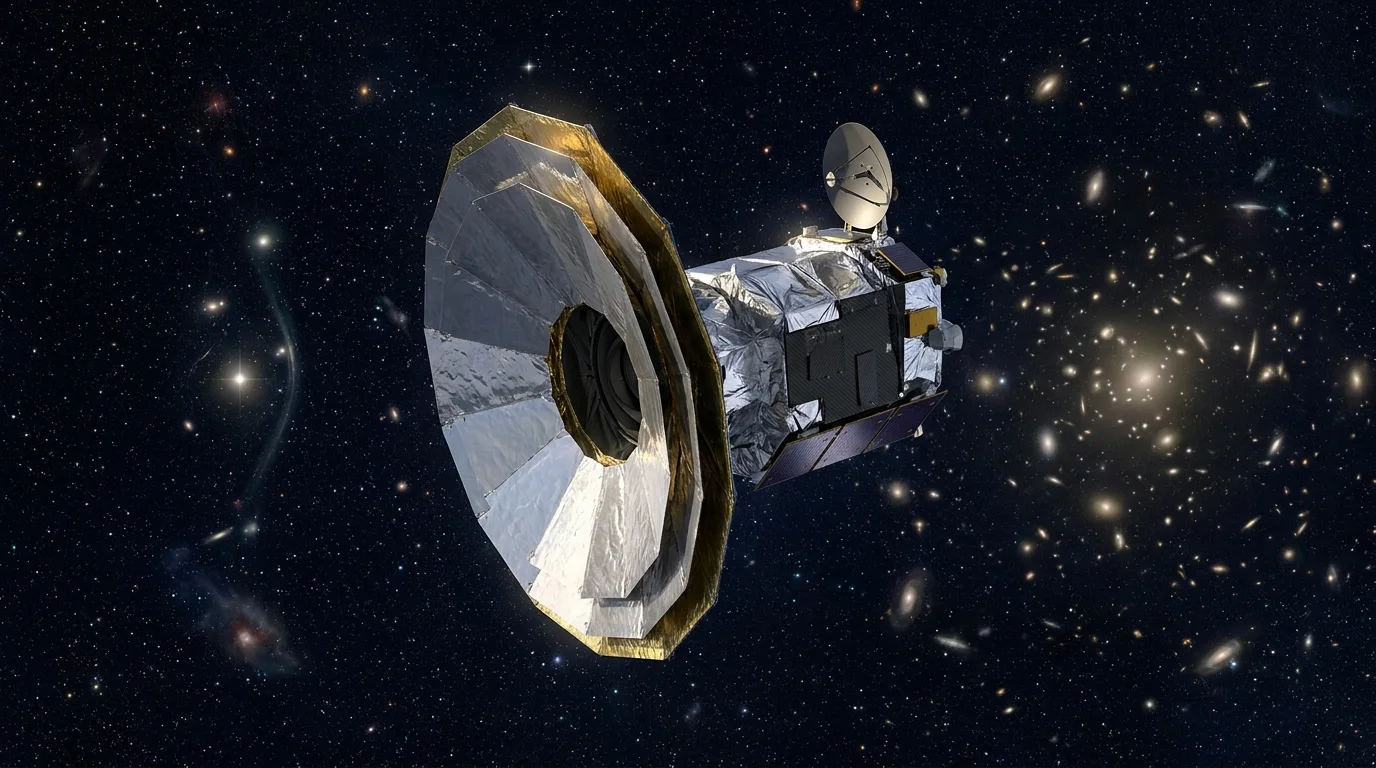
The Nancy Grace Roman Space Telescope is a major new observatory built for wide-field astronomical surveys. Its biggest strength is not simply taking a particularly detailed picture of one object. Roman can collect information from a very large area of sky at once, helping astronomers study vast populations of galaxies and planets instead of relying only on small fields of view. After years of building and testing, NASA launched Roman in August 2026. As of 25 October, the team is still refining its observational performance during commissioning.
Roman should be understood as a complement to existing observatories such as Hubble and the James Webb Space Telescope, not as a replacement that makes those missions obsolete. Different telescopes have different instrument designs, observing wavelengths, fields of view and science priorities. Roman will be especially valuable for large surveys, identifying targets that more narrowly focused instruments may then observe in detail.
What has happened to Roman in 2026?
The telescope's launch history is now part of the public record. NASA reports that Roman lifted off aboard a SpaceX Falcon Heavy rocket from Kennedy Space Center on 30 August 2026. Pre-launch targets mentioned in earlier news reporting were schedules, not observed events. Reports written before launch should now be read in that historical context.
By 22 October, NASA announced the start of science commissioning, after checking the observatory and its primary instrument. The team had established that the telescope could point, guide, acquire exposures and move data through its systems. The next step was to characterise image quality and calibrate instrument responses carefully enough for the planned research programme. NASA also described successful test observations of dense stellar fields and dusty regions that the team had expected to be challenging.
Commissioning does not mean Roman has already completed its flagship surveys or delivered final answers about dark energy and exoplanets. It is the period when scientists determine exactly how the instruments behave, so later survey measurements can be interpreted confidently. For any current mission status, the best source is NASA's own mission page and the Roman mission blog.
Why is Roman different from Hubble and Webb?
A telescope's scientific reach depends on several design choices: the aperture of the mirror, the detectors, the wavelength range, and especially how much sky each exposure covers. Hubble has produced detailed observations of relatively small patches of sky. Webb is exceptionally powerful for carefully targeted infrared investigations. Roman's design emphasises combining sensitivity with a field of view that NASA says is at least one hundred times larger than Hubble's.
That does not mean every Roman image is one hundred times sharper. Field of view and image sharpness are different concepts. A large field of view lets astronomers count and characterise many objects in the same exposure. That is valuable when the scientific question concerns populations: How are galaxies distributed? How often do certain planetary events occur? Does an observed pattern hold across millions of sources rather than just a handful?
A useful comparison is between using a zoom lens to inspect one distant subject and using a wide landscape frame to survey an entire scene. Neither is universally better. The right tool depends on whether the aim is detailed inspection or systematic coverage of a broad region.
The Wide Field Instrument
Roman's Wide Field Instrument is central to its survey strategy. It records light across large areas of the sky using detectors designed for the telescope's observation programme. Survey astronomy also depends on stable pointing, consistent brightness calibration and measurements that remain comparable across repeated observations.
Small variations in focus, detector sensitivity or telescope motion can look like changes in the objects themselves. That is why commissioning includes repeated calibration observations. NASA's October 2026 update emphasised the importance of minimising effects that could otherwise disguise faint scientific signals. A reliable galaxy survey is not just a collection of attractive pictures; it is a system of measurements with controlled uncertainties.
When Roman begins its planned science surveys, researchers will use wide-field images to examine huge numbers of distant sources. The volume of data creates opportunities and challenges: cataloguing objects, distinguishing real signals from instrumental artefacts, tracking observations over time and interpreting selection effects.
What will Roman investigate about dark energy?
One of the telescope's central goals is studying the universe's expansion. Observations of distant galaxies and supernovae help cosmologists test how the expansion rate has changed over time. Dark energy is the name given to the component or behaviour in cosmological models associated with the universe's accelerated expansion, but its physical nature is not yet established.
Roman's wide surveys can contribute large samples of galaxies, cosmic structure measurements and relevant transient events. Astronomers can compare these observations with model predictions and with data from other telescopes. If a result disagrees with a model, that creates a problem to investigate; it does not automatically establish a brand-new physical law.
It is important not to portray Roman as guaranteed to solve dark energy. Scientific instruments are built to test questions, not to guarantee specific discoveries. More precise observations may narrow the range of viable explanations or expose uncertainties that require further work.
Dark matter and the distribution of galaxies
Dark matter is inferred from gravitational effects that ordinary visible matter alone does not explain adequately. Astronomers investigate it using measurements such as how galaxies move and how gravity distorts light from more distant sources. Roman's wide-field data can help map relationships between matter and cosmic structure over large areas.
For example, gravitational lensing can subtly alter the apparent shapes of distant galaxies. Scientists examine statistical patterns across many objects to learn about the matter between us and those galaxies. Careful image calibration matters because a telescope-induced distortion must not be mistaken for one caused by gravity.
Roman is not a detector that will automatically identify a dark-matter particle. Its cosmological observations can constrain the large-scale behaviour of matter, while direct particle searches are pursued through different experiments and instruments.
How Roman can find planets around other stars
Roman will also contribute to exoplanet research. One important method is gravitational microlensing: a foreground star and its planetary system briefly magnify the light of a more distant background star as their positions align. A planet can create an additional feature in the light curve. By following many stars, astronomers can estimate the occurrence of planetary systems that are difficult to study using other discovery methods.
Microlensing does not produce a close-up photograph of the exoplanet. It is an inference from changes in the brightness of background light. Its strength lies in probing planetary populations and orbital separations that complement transit and radial-velocity surveys. Statistical completeness and selection effects matter, because not every system has the same probability of producing a detectable event.
Roman also carries a coronagraph instrument designed to demonstrate technologies relevant to direct imaging. A coronagraph suppresses much of the light from a star so much fainter nearby objects can be studied more effectively. It does not make the star disappear completely, and the success of a technology demonstration should not be confused with a confirmed discovery of life.
For related background, read our explanation of exoplanet direct-imaging technology.
Why calibration matters more than a dramatic first image
New telescopes often create excitement around their first views of space. Such images can demonstrate that the system is working, but reliable research needs far more than an image that looks sharp on a screen. Scientists must know the detector's sensitivity, background noise, pointing stability, response across wavelengths and behaviour across the full image.
Repeated observations help reveal variations in the instrument. The team may use known astronomical sources to compare observed brightness or position with trusted catalogues. A survey then needs a processing pipeline that applies those calibrations consistently and records uncertainty. These practical tasks are a major part of the transition from a functioning telescope to a scientific observatory.
NASA's 22 October 2026 briefing reported that Roman's observing tests were going well and that the team was refining performance before routine science operations. Readers should not assume that every planned Roman research result was already available by this date.
What Roman cannot promise
No single telescope can answer every question in astronomy. Roman cannot by itself prove the nature of dark energy, identify all dark matter, photograph every exoplanet, or determine whether life exists elsewhere. Its data will be interpreted alongside theoretical models and other observations. Results will also be subject to uncertainty, calibration limits and scientific debate.
Nor should mission dates be read as permanent. The launch date is now historical, but the commissioning schedule, survey timelines and publication of science results can evolve. A science-news page that originally described a future launch needs a dated update—something this page now includes—instead of silently pretending the old forecast is still current.
Questions readers often ask
Has Roman already launched?
Yes. NASA records Roman's launch on 30 August 2026.
Is Roman already conducting all its planned science surveys?
NASA reported on 22 October 2026 that the telescope had entered its final science commissioning phase. Commissioning and the full planned survey programme are not the same stage.
Will Roman replace Hubble or Webb?
No. Roman's wide-field surveys complement the detailed investigations made by other observatories.
Does Roman's coronagraph mean NASA has found life on an exoplanet?
No. A technology demonstration is not a discovery of life; such a claim would require independent, extraordinary evidence.
Sources and further reading
- NASA: Nancy Grace Roman Space Telescope mission overview
- NASA: Roman launch record, 30 August 2026
- NASA: Roman enters final commissioning, 22 October 2026
Editorial source check performed 25 October 2026. Historical publication metadata has not been altered to imply the entire article was originally published today.