wp:paragraph
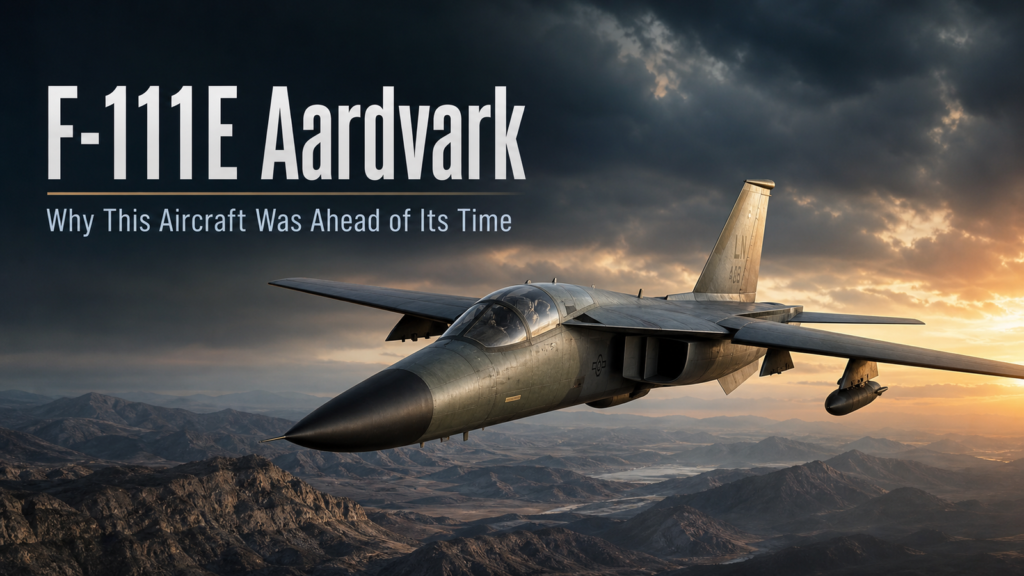
Some aircraft become famous because they look beautiful. Others become famous because they win battles, break speed records, or introduce new technology. The F-111E Aardvark earned its place in aviation history for a different reason: it tried to solve several major military aviation problems at once.
/wp:paragraph
wp:paragraph
It was designed to fly fast, fly low, carry heavy weapons, operate in bad weather, travel long distances, and strike targets deep inside enemy territory. That combination was extremely ambitious for its time.
/wp:paragraph
wp:paragraph
During the Cold War, air forces faced a difficult problem. Flying high made aircraft vulnerable to advanced surface-to-air missiles and radar systems. Flying low helped avoid detection, but low-level flight was dangerous, exhausting, and technically demanding. A pilot had to follow the shape of the terrain at high speed, often in darkness or bad weather. One small mistake could be fatal.
/wp:paragraph
wp:paragraph
The F-111 was built for that kind of mission.
/wp:paragraph
wp:paragraph
The F-111E Aardvark was one of the important strike variants of the General Dynamics F-111 family. It was not a simple fighter, and it was not a traditional bomber. It was a long-range, all-weather strike aircraft designed to penetrate enemy air defenses at low altitude and deliver weapons accurately.
/wp:paragraph
wp:paragraph
What made it ahead of its time was not one feature. It was the combination: variable-sweep wings, afterburning turbofan engines, terrain-following radar, side-by-side crew seating, long range, heavy payload, and all-weather attack capability.
/wp:paragraph
wp:paragraph
In simple words, the F-111E was built around a future idea: a strike aircraft should be able to fly fast and low, day or night, in difficult weather, and reach targets that other aircraft might struggle to attack.
/wp:paragraph
wp:heading
Accuracy note
/wp:heading
wp:paragraph
This article explains the F-111E Aardvark as a historical military aviation topic. It is written for educational and aviation-history purposes. It does not claim that the F-111E is still in active U.S. Air Force service. The F-111 family served the U.S. Air Force from the 1960s until the 1990s, while the Royal Australian Air Force continued flying its F-111 variants until 2010. The F-111E specifically should be understood as a Cold War strike aircraft that helped demonstrate ideas later seen in modern deep-strike and precision-attack aircraft.
/wp:paragraph
wp:heading
Key Facts About the F-111E Aardvark
/wp:heading
wp:table
| Feature | Details |
|---|---|
| Aircraft | General Dynamics F-111E Aardvark |
| Type | Long-range, all-weather strike aircraft |
| Manufacturer | General Dynamics |
| Crew | Two: pilot and weapons systems officer |
| Seating | Side-by-side cockpit arrangement |
| Wings | Variable-geometry swing wings |
| Main Role | Low-level deep strike and interdiction |
| Engines | Two Pratt & Whitney TF30 turbofan engines |
| Number Built | 94 F-111E models |
| Major Operator | U.S. Air Force |
| Major Base | RAF Upper Heyford, United Kingdom |
| Historic Strength | Fast, low-level, all-weather strike capability |
/wp:table
wp:paragraph
These facts show why the F-111E deserves attention. It was not only powerful for its time; it also introduced a design philosophy that shaped later strike aircraft thinking.
/wp:paragraph
wp:heading
What Was the F-111E Aardvark?
/wp:heading
wp:paragraph
The F-111E Aardvark was a variant of the General Dynamics F-111, a supersonic, long-range strike aircraft developed during the Cold War. It was designed to attack targets deep inside enemy territory while flying at low altitude and high speed.
/wp:paragraph
wp:paragraph
The aircraft carried two crew members: a pilot and a weapons systems officer. Unlike many fighters where the crew sits one behind the other, the F-111 used side-by-side seating. This allowed the pilot and weapons systems officer to work closely together during demanding low-level attack missions.
/wp:paragraph
wp:paragraph
The F-111E was part of a larger aircraft family that included the F-111A, F-111D, F-111F, FB-111A, and EF-111A Raven. Each variant had differences in avionics, engines, mission equipment, or role.
/wp:paragraph
wp:paragraph
The F-111E was introduced as a more practical variant after delays and complexity affected the F-111D. It used improved air intakes compared with the F-111A but kept more proven avionics. That made it less advanced than the F-111D in some ways, but also more reliable and operationally useful.
/wp:paragraph
wp:paragraph
This is one reason the F-111E is interesting. Sometimes being “ahead of its time” does not mean having the most complicated electronics. It can mean combining advanced ideas with enough reliability to be useful in real service.
/wp:paragraph
wp:paragraph
For more technology explainers, visit our Future & Technology section.
/wp:paragraph
wp:heading
Why the F-111E Was Called the Aardvark
/wp:heading
wp:paragraph
The F-111 was long known unofficially as the “Aardvark.” The name made sense because the aircraft had a long nose and a low-level hunting role. Like an aardvark searching close to the ground, the F-111 was built to fly low and strike deep.
/wp:paragraph
wp:paragraph
Interestingly, the U.S. Air Force did not officially adopt the Aardvark name until the aircraft’s retirement ceremony in 1996. Before that, the nickname had already become widely associated with the aircraft.
/wp:paragraph
wp:paragraph
The name also reflected the aircraft’s unusual appearance. The F-111 had a long fuselage, variable-sweep wings, a wide cockpit, and a distinctive profile. It did not look like a traditional fighter, and it did not fly missions like one.
/wp:paragraph
wp:paragraph
The nickname may sound informal, but it became part of aviation history because it captured the aircraft’s personality: unusual, low-flying, powerful, and specialized.
/wp:paragraph
wp:heading
The Cold War Problem the F-111 Tried to Solve
/wp:heading
wp:paragraph
To understand why the F-111E was advanced, it helps to understand the Cold War environment.
/wp:paragraph
wp:paragraph
By the late 1950s and early 1960s, air defense systems were becoming more dangerous. High-flying bombers and reconnaissance aircraft were increasingly vulnerable to radar-guided missiles and interceptors. One response was to fly lower, where radar detection was harder and reaction time was shorter.
/wp:paragraph
wp:paragraph
But flying low created new problems.
/wp:paragraph
wp:paragraph
At low altitude, the aircraft has less time to react to hills, trees, towers, terrain changes, and weather. Flying fast at low level is physically demanding and risky. It also requires excellent navigation and sensors.
/wp:paragraph
wp:paragraph
The F-111 was designed to solve this problem by combining high speed with terrain-following technology. It could fly very low and use radar-linked systems to follow the shape of the ground.
/wp:paragraph
wp:paragraph
This made the aircraft extremely valuable for deep strike missions, where surprise, speed, range, and all-weather capability mattered.
/wp:paragraph
wp:heading
Swing Wings: The Feature Everyone Remembers
/wp:heading
wp:paragraph
The F-111’s most famous feature was its variable-geometry wing, often called a swing wing. The wings could move forward or sweep backward depending on the flight condition.
/wp:paragraph
wp:paragraph
When the wings were extended forward, the aircraft had better lift for takeoff, landing, and slower flight. When the wings were swept back, the aircraft became better suited for high-speed flight.
/wp:paragraph
wp:paragraph
This gave the F-111 a major advantage. It could combine some benefits of a straight-wing aircraft with some benefits of a swept-wing supersonic aircraft.
/wp:paragraph
wp:paragraph
A fixed-wing design usually forces compromise. A wing that is good for high-speed flight may not be ideal for takeoff and landing. A wing that is good for slower flight may create too much drag at high speed. The swing wing allowed the F-111 to change shape in flight.
/wp:paragraph
wp:paragraph
Example: during takeoff or landing, the F-111 could keep its wings forward for better lift. During a high-speed low-level dash, it could sweep the wings back to reduce drag and improve performance.
/wp:paragraph
wp:paragraph
This made the F-111 one of the most recognizable swing-wing aircraft in aviation history.
/wp:paragraph
wp:heading
Why Swing Wings Were Ahead of Their Time
/wp:heading
wp:paragraph
Swing wings were important because they gave one aircraft multiple flight personalities. The F-111 could act like a heavy strike aircraft during takeoff and landing, then transform into a fast low-level penetrator during the mission.
/wp:paragraph
wp:paragraph
This was especially useful because the F-111 had to carry fuel, weapons, and mission equipment over long distances. A simple lightweight fighter design would not have been enough.
/wp:paragraph
wp:paragraph
The swing-wing idea later appeared in other aircraft, including the F-14 Tomcat, B-1 Lancer, Panavia Tornado, and several Soviet designs. That shows how influential the concept became during the Cold War.
/wp:paragraph
wp:paragraph
However, swing wings also had disadvantages. They added mechanical complexity, weight, maintenance needs, and structural challenges. Later aircraft designs often moved away from swing wings because improved engines, materials, flight controls, and aerodynamic design made fixed-wing solutions more practical.
/wp:paragraph
wp:paragraph
Still, for its era, the F-111’s swing wing was a major technological achievement.
/wp:paragraph
wp:heading
Terrain-Following Radar: The Aircraft’s Secret Weapon
/wp:heading
wp:paragraph
The F-111E’s most important feature may not have been its wings. It may have been its terrain-following capability.
/wp:paragraph
wp:paragraph
Terrain-following radar helped the aircraft fly at very low altitude by reading the terrain ahead and supporting flight close to the ground. This allowed the aircraft to penetrate defended areas while reducing exposure to enemy radar.
/wp:paragraph
wp:paragraph
This was extremely advanced for the time. Low-level flight in bad weather or darkness is dangerous because the crew cannot always see terrain clearly. A terrain-following system allowed the aircraft to maintain low-level flight more safely and consistently.
/wp:paragraph
wp:paragraph
The National Museum of the U.S. Air Force notes that the F-111 could fly at very low level and hit targets in bad weather. That capability was one of the reasons the aircraft stood apart from older strike aircraft.
/wp:paragraph
wp:paragraph
Example: imagine a strike aircraft flying at night through poor weather toward a heavily defended target. A conventional aircraft might need better visibility, higher altitude, or more support. The F-111 was designed to fly low and use its systems to reach the target even when conditions were poor.
/wp:paragraph
wp:paragraph
This made the aircraft a true all-weather deep-strike platform.
/wp:paragraph
wp:heading
Why Low-Level Speed Mattered
/wp:heading
wp:paragraph
Low-level speed mattered because it reduced enemy reaction time. If an aircraft flies low and fast, radar may detect it later, and defenders have less time to respond.
/wp:paragraph
wp:paragraph
The F-111 was built around this idea. It could approach targets at low altitude, use terrain masking, and deliver weapons before leaving the area quickly.
/wp:paragraph
wp:paragraph
This was not about dogfighting. The F-111E was not designed to turn like a lightweight fighter or win close-range air combat. Its strength was reaching defended targets with speed, range, and precision.
/wp:paragraph
wp:paragraph
This is why calling it only a “fighter” can be misleading. The F-111 was officially part of the fighter designation series, but its real role was closer to a strike aircraft or tactical bomber.
/wp:paragraph
wp:paragraph
In practical terms, it was designed to go where the target was, not to circle in a dogfight.
/wp:paragraph
wp:heading
The Crew: Pilot and Weapons Systems Officer
/wp:heading
wp:paragraph
The F-111E had a two-person crew. The pilot controlled the aircraft, while the weapons systems officer handled navigation, attack systems, sensors, and mission tasks.
/wp:paragraph
wp:paragraph
The side-by-side cockpit layout was unusual for a tactical aircraft. Many two-seat combat aircraft place the second crew member behind the pilot. The F-111 placed them next to each other.
/wp:paragraph
wp:paragraph
This layout had advantages. The crew could communicate more naturally and share workload during complex missions. In a low-level, all-weather strike aircraft, workload management was critical.
/wp:paragraph
wp:paragraph
The weapons systems officer was not a passenger. This role was central to the mission. The WSO helped manage navigation, radar, weapons delivery, and systems monitoring.
/wp:paragraph
wp:paragraph
Example: during a low-level night strike, the pilot might focus heavily on flying and aircraft handling, while the WSO manages navigation, radar, and attack systems. That crew teamwork allowed the F-111E to handle missions that would have overloaded a single pilot.
/wp:paragraph
wp:heading
The Escape Crew Capsule
/wp:heading
wp:paragraph
Another unusual feature of the F-111 family was its escape crew capsule. Instead of using two separate ejection seats in the conventional way, the entire cockpit crew module could separate from the aircraft in an emergency.
/wp:paragraph
wp:paragraph
This concept was designed to protect the crew across a wide range of speeds and altitudes. It was especially relevant because the F-111 was expected to fly fast and low, where emergency escape could be extremely dangerous.
/wp:paragraph
wp:paragraph
The capsule added weight and complexity, but it showed how different the F-111 was from many aircraft of its era. Designers were thinking about crew survival in extreme mission conditions.
/wp:paragraph
wp:paragraph
The escape capsule was one more example of the F-111’s advanced but complicated design philosophy.
/wp:paragraph
wp:heading
The F-111E Variant: What Made It Different?
/wp:heading
wp:paragraph
The F-111E was not the first F-111 model. The earliest production model was the F-111A. The F-111D was intended to bring more advanced avionics, but its complexity and delays created problems.
/wp:paragraph
wp:paragraph
The F-111E was ordered as a more practical interim variant. It used improved Triple Plow II engine intakes but retained more proven avionics similar to the F-111A. Its weapon stores management system was improved, and it included other smaller changes.
/wp:paragraph
wp:paragraph
This gave the F-111E an interesting place in the aircraft family. It was not the most advanced F-111 variant, but it was an important operational version.
/wp:paragraph
wp:paragraph
A total of 94 F-111E models were built, according to the Air Force Armament Museum Foundation. Many served with the 20th Tactical Fighter Wing at RAF Upper Heyford in the United Kingdom.
/wp:paragraph
wp:paragraph
The F-111E showed that reliability and operational usefulness can matter as much as technical ambition.
/wp:paragraph
wp:heading
RAF Upper Heyford and the F-111E
/wp:heading
wp:paragraph
The F-111E is strongly associated with RAF Upper Heyford in the United Kingdom. The Museum of Aviation notes that one F-111E on display was delivered to the U.S. Air Force in November 1970, assigned first to Cannon Air Force Base, and then transferred in January 1971 to the 20th Tactical Fighter Wing at RAF Upper Heyford.
/wp:paragraph
wp:paragraph
Shaw Air Force Base also notes that F-111E aircraft arrived at RAF Upper Heyford in 1970, beginning a new era for the 20th Fighter Wing.
/wp:paragraph
wp:paragraph
This matters because RAF Upper Heyford placed the aircraft in a key Cold War position. From the United Kingdom, F-111Es could support NATO missions and respond to European security needs.
/wp:paragraph
wp:paragraph
The aircraft’s long range and low-level strike capability made it suitable for Cold War deterrence and deep-strike planning.
/wp:paragraph
wp:heading
F-111E Specifications
/wp:heading
wp:table
| Specification | F-111E Aardvark |
|---|---|
| Crew | Two |
| Manufacturer | General Dynamics |
| Wingspan | 32 ft swept, 63 ft extended |
| Length | 73 ft 6 in |
| Height | 17 ft |
| Maximum Speed | About 1,425–1,452 mph, depending on source/configuration |
| Cruising Speed | About 685 mph |
| Range | About 3,500+ miles with tanks |
| Service Ceiling | Around 57,000–60,000 ft |
| Armament | 20mm cannon and conventional or nuclear weapons capability |
| Engines | Two Pratt & Whitney TF30 turbofans |
/wp:table
wp:paragraph
These numbers show why the F-111E was impressive. It had fighter-like speed, bomber-like range, and advanced navigation technology for its era.
/wp:paragraph
wp:heading
Weapons and Strike Capability
/wp:heading
wp:paragraph
The F-111E could carry a mix of conventional or nuclear weapons. It had a 20mm cannon and could carry bombs internally and on external pylons.
/wp:paragraph
wp:paragraph
The aircraft was designed for deep strike, not air superiority. Its main job was to reach ground targets and deliver weapons accurately, even in difficult conditions.
/wp:paragraph
wp:paragraph
Later F-111 variants, especially the F-111F, became strongly associated with precision strike using systems such as Pave Tack. The F-111E did not represent the final peak of the F-111 family’s precision capability, but it helped establish the platform’s reputation as a long-range strike aircraft.
/wp:paragraph
wp:paragraph
The important point is that the F-111E was designed around mission effectiveness. It could carry significant ordnance, fly long distances, and attack targets that required low-level penetration.
/wp:paragraph
wp:heading
Why the F-111E Was Not a Dogfighter
/wp:heading
wp:paragraph
Despite the “F” designation, the F-111E was not a classic fighter in the dogfighting sense. It was large, heavy, and optimized for speed, range, and strike missions.
/wp:paragraph
wp:paragraph
It was not built to turn tightly against enemy fighters like an F-16 or F-15. Its mission was different. It was designed to penetrate, strike, and leave.
/wp:paragraph
wp:paragraph
This is one reason the aircraft is sometimes misunderstood. People hear “F-111” and assume it was mainly an air-to-air fighter. In reality, it was closer to a tactical bomber or strike aircraft.
/wp:paragraph
wp:paragraph
Example: an F-16 might be sent to fight for air superiority or attack tactical targets. An F-111E was more suited to deep interdiction: flying far, flying low, and attacking an important target behind enemy lines.
/wp:paragraph
wp:paragraph
Understanding that role makes the aircraft easier to appreciate.
/wp:paragraph
wp:heading
Why the F-111E Was Ahead of Its Time
/wp:heading
wp:paragraph
The F-111E was ahead of its time because it combined technologies and mission ideas that became more common later.
/wp:paragraph
wp:paragraph
First, it used variable-sweep wings to adapt to different flight conditions.
/wp:paragraph
wp:paragraph
Second, it used terrain-following systems for low-level penetration.
/wp:paragraph
wp:paragraph
Third, it had long range and heavy payload.
/wp:paragraph
wp:paragraph
Fourth, it operated in all-weather conditions.
/wp:paragraph
wp:paragraph
Fifth, it used a two-person crew to manage complex mission systems.
/wp:paragraph
wp:paragraph
Sixth, it showed the value of integrated avionics for deep strike.
/wp:paragraph
wp:paragraph
Seventh, it focused on survivability through speed, low altitude, and automation.
/wp:paragraph
wp:paragraph
Many later aircraft did not copy the F-111 directly, but they followed the same operational idea: a strike aircraft should combine sensors, navigation, weapons, and flight control into one mission system.
/wp:paragraph
wp:paragraph
That is why the F-111E matters. It helped point the way toward modern strike aircraft thinking.
/wp:paragraph
wp:heading
Example: Why Terrain Following Was Revolutionary
/wp:heading
wp:paragraph
A useful way to understand the F-111E is to imagine two aircraft trying to attack a defended target at night.
/wp:paragraph
wp:paragraph
The first aircraft has to fly higher because it cannot safely follow terrain in poor visibility. Enemy radar sees it earlier, and defenses have more time to respond.
/wp:paragraph
wp:paragraph
The second aircraft is an F-111E. It flies lower, uses terrain-following radar, approaches under more difficult detection conditions, and reaches the target with less warning.
/wp:paragraph
wp:paragraph
That was the promise of the F-111 concept.
/wp:paragraph
wp:paragraph
It did not make the aircraft invincible. No aircraft is invincible. But it gave the crew a way to perform dangerous missions that would have been much harder for older strike aircraft.
/wp:paragraph
wp:paragraph
This is exactly why the F-111 was so advanced for its era.
/wp:paragraph
wp:heading
The F-111E and Operation Desert Storm
/wp:heading
wp:paragraph
The F-111 family played an important role in Operation Desert Storm in 1991. F-111 aircraft became known for long-range strike missions and attacks against Iraqi targets.
/wp:paragraph
wp:paragraph
The F-111E served during the Gulf War, although the F-111F often receives more attention because of its precision strike role with Pave Tack.
/wp:paragraph
wp:paragraph
The key point is that the F-111 family proved its usefulness over decades. An aircraft designed in the 1960s remained relevant into the 1990s because its core mission concept was strong.
/wp:paragraph
wp:paragraph
By the time of Desert Storm, modern precision warfare was becoming more visible. The F-111 family helped show how long-range strike aircraft with advanced sensors and weapons could shape an air campaign.
/wp:paragraph
wp:heading
Comparison: F-111E vs F-111F
/wp:heading
wp:table
| Feature | F-111E | F-111F |
|---|---|---|
| Role | Long-range all-weather strike | Advanced long-range precision strike |
| Engines | TF30-P-3 series | More powerful TF30-P-100/P-109 series |
| Avionics | More proven, less complex than F-111D | More advanced strike avionics |
| Precision Strike Reputation | Important strike platform | Strongly associated with Pave Tack and laser-guided bombs |
| Production | 94 built | 106 built |
| Operational Identity | Closely linked with RAF Upper Heyford | Known for Libya 1986 and Desert Storm precision attacks |
/wp:table
wp:paragraph
This comparison helps explain the F-111E’s place in the family. It was not the most famous precision-strike version, but it was a vital operational model and an important Cold War aircraft.
/wp:paragraph
wp:heading
Comparison: F-111E vs Modern Strike Aircraft
/wp:heading
wp:table
| Feature | F-111E Aardvark | Modern Strike Aircraft |
|---|---|---|
| Low-Level Penetration | Terrain-following radar and high speed | Often uses stealth, sensors, and standoff weapons |
| Wing Design | Variable-sweep wings | Usually fixed wings with advanced aerodynamics |
| Crew | Two-person crew | One or two depending on aircraft |
| Survivability | Speed, low altitude, all-weather flight | Stealth, electronic warfare, networking, standoff weapons |
| Weapons | Conventional and nuclear strike capability | Precision-guided weapons, standoff missiles, networked targeting |
| Technology Philosophy | Mechanical and avionics innovation | Digital systems, stealth, sensor fusion, data links |
/wp:table
wp:paragraph
Modern aircraft did not make the F-111 meaningless. They inherited many of the problems it tried to solve: how to strike defended targets, survive enemy air defenses, and deliver weapons accurately.
/wp:paragraph
wp:paragraph
The solutions changed, but the mission challenge remained.
/wp:paragraph
wp:heading
Strengths of the F-111E
/wp:heading
wp:paragraph
The F-111E had several major strengths.
/wp:paragraph
wp:paragraph
Its range allowed it to reach distant targets.
/wp:paragraph
wp:paragraph
Its speed helped it penetrate and escape.
/wp:paragraph
wp:paragraph
Its terrain-following capability allowed low-level flight in difficult conditions.
/wp:paragraph
wp:paragraph
Its swing wings allowed a wider flight envelope.
/wp:paragraph
wp:paragraph
Its two-person crew helped manage complex missions.
/wp:paragraph
wp:paragraph
Its payload capacity made it useful for serious strike missions.
/wp:paragraph
wp:paragraph
Its all-weather capability gave commanders more flexibility.
/wp:paragraph
wp:paragraph
These strengths made the F-111E valuable during the Cold War, especially for NATO planning in Europe.
/wp:paragraph
wp:heading
Weaknesses and Problems
/wp:heading
wp:paragraph
The F-111E was advanced, but it was not perfect.
/wp:paragraph
wp:paragraph
The F-111 program had a troubled development history. The attempt to create one aircraft for both U.S. Air Force and Navy needs created serious compromises. The Navy’s F-111B version was eventually canceled.
/wp:paragraph
wp:paragraph
The aircraft was complex and expensive to maintain. Swing wings, advanced avionics, terrain-following systems, and specialized equipment required skilled maintenance.
/wp:paragraph
wp:paragraph
It was also large and heavy. It was not a close-in dogfighter.
/wp:paragraph
wp:paragraph
Some early F-111 variants had reliability problems, especially during development. Later improvements helped the aircraft become more effective, but the program’s early reputation suffered.
/wp:paragraph
wp:paragraph
A fair article should include these weaknesses. The F-111E was ahead of its time, but it was also a reminder that advanced technology often comes with cost and complexity.
/wp:paragraph
wp:heading
Why the F-111E Still Matters Today
/wp:heading
wp:paragraph
The F-111E matters today because it shows how aircraft design responds to military problems.
/wp:paragraph
wp:paragraph
It was not designed for beauty or simplicity. It was designed around a mission: fly low, fly fast, go far, and attack in all weather.
/wp:paragraph
wp:paragraph
That mission shaped everything about the aircraft. The swing wings, terrain-following radar, crew layout, engines, payload, and range all supported the same goal.
/wp:paragraph
wp:paragraph
Modern aircraft may use stealth instead of terrain hugging. They may use digital sensors instead of analog avionics. They may use standoff weapons instead of direct low-level penetration. But the F-111E helped define the idea of the integrated deep-strike aircraft.
/wp:paragraph
wp:paragraph
For readers interested in advanced technology beyond aviation, you can also explore our article on AI with long-term memory, which explains how modern systems increasingly depend on integrated sensing, memory, and decision support.
/wp:paragraph
wp:heading
What People Often Get Wrong About the F-111E
/wp:heading
wp:paragraph
Many people think the F-111E was a normal fighter. It was not. It was a strike aircraft optimized for deep attack.
/wp:paragraph
wp:paragraph
Another mistake is thinking the F-111 was officially called Aardvark from the beginning. The name was unofficial for much of its service life and became official at retirement.
/wp:paragraph
wp:paragraph
Some people think swing wings were only for style. In reality, they solved a serious aerodynamic problem by helping the aircraft perform at different speeds.
/wp:paragraph
wp:paragraph
Another misunderstanding is thinking terrain-following radar was just a navigation aid. It was central to the aircraft’s low-level mission concept.
/wp:paragraph
wp:paragraph
Some people also assume the F-111E was the most advanced F-111 variant. It was important, but the F-111F later became the most famous tactical version for precision strike.
/wp:paragraph
wp:paragraph
A final mistake is judging the F-111 only by its early problems. The aircraft had a difficult beginning, but it matured into a capable long-range strike platform.
/wp:paragraph
wp:heading
Timeline: F-111E and the Aardvark Family
/wp:heading
wp:table
| Period | Event |
|---|---|
| Early 1960s | F-111 developed under the TFX program |
| December 1964 | F-111A first flew |
| 1967 | First production F-111s delivered to the U.S. Air Force |
| Late 1960s | F-111E developed as a more practical variant after F-111D delays |
| 1969–1971 | 94 F-111E aircraft built |
| 1970 | F-111E began entering 20th Tactical Fighter Wing history |
| 1971 | F-111E aircraft transferred to RAF Upper Heyford service |
| 1991 | F-111E aircraft served during the Gulf War era |
| 1993 | Some F-111E aircraft retired from RAF Upper Heyford service |
| 1996 | F-111 officially received the Aardvark name at USAF retirement |
| 1998 | EF-111A Raven variant retired from U.S. Air Force service |
| 2010 | Royal Australian Air Force retired its F-111 variants |
/wp:table
wp:paragraph
This timeline shows that the F-111E was part of a long service story. It was born in the Cold War and remained relevant into the precision-strike era.
/wp:paragraph
wp:heading
Why Aviation Fans Still Respect the F-111E
/wp:heading
wp:paragraph
Aviation fans respect the F-111E because it was bold. It tried to do things that were extremely difficult in its time.
/wp:paragraph
wp:paragraph
It was not a simple aircraft, and it was not always easy to maintain. But its design had purpose. Every major feature supported the mission.
/wp:paragraph
wp:paragraph
The aircraft also had presence. Its long nose, wide cockpit, large body, and swing wings made it instantly recognizable. It looked powerful because it was built for power.
/wp:paragraph
wp:paragraph
It also represented an era when engineers were willing to solve problems mechanically and electronically in ambitious ways. Swing wings, escape capsules, terrain-following radar, and long-range supersonic flight all belonged to that mindset.
/wp:paragraph
wp:paragraph
The F-111E was not perfect, but it was unforgettable.
/wp:paragraph
wp:heading
Practical Reader Takeaway
/wp:heading
wp:paragraph
The F-111E Aardvark was ahead of its time because it combined speed, range, payload, automation, terrain-following radar, and swing-wing design in one aircraft.
/wp:paragraph
wp:paragraph
It was built for a mission that was extremely difficult: low-level, all-weather deep strike during the Cold War.
/wp:paragraph
wp:paragraph
Its technology was complex, but its purpose was clear. It helped prove that aircraft could use advanced avionics and aerodynamic design to attack targets in ways older aircraft could not.
/wp:paragraph
wp:paragraph
The F-111E should not be remembered only as a strange-looking Cold War jet. It should be remembered as one of the aircraft that helped define modern strike aviation.
/wp:paragraph
wp:heading
Frequently Asked Questions
/wp:heading
wp:heading {“level”:3}
What was the F-111E Aardvark?
/wp:heading
wp:paragraph
The F-111E Aardvark was a U.S. Air Force long-range, all-weather strike aircraft built by General Dynamics. It was designed for low-level penetration and deep strike missions.
/wp:paragraph
wp:heading {“level”:3}
Was the F-111E a fighter or a bomber?
/wp:heading
wp:paragraph
Although it had an “F” designation, the F-111E was mainly a strike aircraft or tactical bomber. It was not designed primarily for dogfighting.
/wp:paragraph
wp:heading {“level”:3}
Why was the F-111E ahead of its time?
/wp:heading
wp:paragraph
It combined swing wings, terrain-following radar, long range, supersonic performance, all-weather strike capability, and a two-person crew system at a time when this combination was highly advanced.
/wp:paragraph
wp:heading {“level”:3}
What made the F-111E’s wings special?
/wp:heading
wp:paragraph
The F-111E had variable-sweep wings. They could extend forward for takeoff and landing, then sweep backward for high-speed flight.
/wp:paragraph
wp:heading {“level”:3}
What was terrain-following radar?
/wp:heading
wp:paragraph
Terrain-following radar helped the aircraft fly very low by detecting terrain ahead and supporting low-altitude flight. This allowed the F-111E to penetrate enemy defenses more effectively.
/wp:paragraph
wp:heading {“level”:3}
How many F-111E aircraft were built?
/wp:heading
wp:paragraph
A total of 94 F-111E models were built.
/wp:paragraph
wp:heading {“level”:3}
Where did the F-111E serve?
/wp:heading
wp:paragraph
Many F-111E aircraft served with the 20th Tactical Fighter Wing at RAF Upper Heyford in the United Kingdom.
/wp:paragraph
wp:heading {“level”:3}
Did the F-111E serve in combat?
/wp:heading
wp:paragraph
Yes. F-111E aircraft served during the Gulf War era. The broader F-111 family also served in Vietnam, Libya-related operations, Desert Storm, and other roles depending on variant.
/wp:paragraph
wp:heading {“level”:3}
When was the F-111 retired?
/wp:heading
wp:paragraph
The U.S. Air Force retired the F-111 family in the 1990s. The F-111 officially received the Aardvark name during its 1996 retirement ceremony.
/wp:paragraph
wp:heading {“level”:3}
Is the F-111E still flying today?
/wp:heading
wp:paragraph
No. The F-111E is no longer in active U.S. Air Force service. Surviving aircraft are preserved in museums and air parks.
/wp:paragraph
wp:heading
Conclusion
/wp:heading
wp:paragraph
The F-111E Aardvark was one of the most ambitious strike aircraft of the Cold War. It was designed to solve a hard problem: how to fly fast, low, far, and accurately in all weather while carrying a serious weapons load.
/wp:paragraph
wp:paragraph
Its swing wings allowed it to adapt to different flight conditions. Its terrain-following radar supported dangerous low-level missions. Its side-by-side crew layout helped manage workload. Its range and payload made it a powerful deep-strike aircraft. Its service with units such as the 20th Tactical Fighter Wing at RAF Upper Heyford made it a key part of Cold War aviation history.
/wp:paragraph
wp:paragraph
The aircraft was not flawless. It was complex, expensive, and born from a difficult development program. But that does not erase its importance. Many advanced aircraft begin with problems because they push technology beyond what is comfortable.
/wp:paragraph
wp:paragraph
The simplest way to understand the F-111E is this: it was not a normal fighter, and it was not a normal bomber. It was a fast, low-level, all-weather strike machine built around ideas that were far ahead of their time.
/wp:paragraph
wp:paragraph
That is why the F-111E Aardvark still deserves attention today. It helped shape the future of strike aviation by proving that advanced avionics, variable geometry, long range, and low-level penetration could be combined into one powerful aircraft.
/wp:paragraph
wp:heading
Sources and Further Reading
/wp:heading
wp:paragraph
National Museum of the U.S. Air Force: General Dynamics F-111A Aardvark
/wp:paragraph
wp:paragraph
National Museum of the U.S. Air Force: General Dynamics F-111F Aardvark
/wp:paragraph
wp:paragraph
Museum of Aviation: F-111E Aardvark
/wp:paragraph
wp:paragraph
Air Force Armament Museum Foundation: General Dynamics F-111E Aardvark
/wp:paragraph
wp:paragraph
Shaw Air Force Base: F-111E Dedication
/wp:paragraph
wp:paragraph
Imperial War Museums: F-111 Aardvark — The Flying Pig
/wp:paragraph