wp:paragraph
I still remember the first time I used a sky map app properly instead of just staring at the sky and guessing. I pointed my phone toward a bright object near the Moon, expecting it to be a star. It was Jupiter.
/wp:paragraph
wp:paragraph
That small moment changed how I looked at the night sky. Suddenly, space was not just something from textbooks, NASA documentaries, or school posters. It felt closer. Real. Moving. Alive.
/wp:paragraph
wp:paragraph
The strange thing is that the more you learn about space, the less “normal” the universe feels. A planet can have a day longer than its year. The Moon is slowly moving away from Earth. A black hole can stretch matter like spaghetti. A neutron star can crush more mass than the Sun into something roughly city-sized. And the International Space Station moves so fast that it goes around Earth about every 90 minutes.
/wp:paragraph
wp:paragraph
When people search for space facts, they usually expect quick trivia. But the best space facts are not just random facts. They make you stop for a second and think, “Wait… how is that even possible?”
/wp:paragraph
wp:paragraph
So here are 25 space facts that reveal how strange the universe really is, explained in a simple way without making it feel like a physics lecture.
/wp:paragraph
wp:heading
1. The Sun holds almost the entire mass of our solar system
/wp:heading
wp:paragraph
The Sun is not just the brightest object in our sky. It is the heavyweight of the entire solar system.
/wp:paragraph
wp:paragraph
According to NASA’s Sun facts, the Sun accounts for about 99.8% of the mass of the whole solar system. That means all the planets, moons, asteroids, comets, dust, and everything else share only a tiny leftover amount.
/wp:paragraph
wp:paragraph
This completely changes how we imagine the solar system. In school diagrams, planets often look important and evenly spaced. But in reality, the Sun dominates almost everything gravitationally.
/wp:paragraph
wp:paragraph
A simple way to imagine it is this: if the solar system were a group project, the Sun did almost all the work.
/wp:paragraph
wp:heading
2. Venus is hotter than Mercury, even though Mercury is closer to the Sun
/wp:heading
wp:paragraph
Most people naturally assume Mercury should be the hottest planet because it is closest to the Sun. But Venus is hotter.
/wp:paragraph
wp:paragraph
The reason is Venus’ thick atmosphere. It traps heat extremely well, creating a runaway greenhouse effect. NASA describes Venus as the hottest planet in our solar system, with surface temperatures hot enough to melt lead.
/wp:paragraph
wp:paragraph
This is one of my favorite examples because it teaches an important lesson: distance from the Sun is not the only thing that controls a planet’s temperature.
/wp:paragraph
wp:paragraph
Atmosphere matters. A lot.
/wp:paragraph
wp:paragraph
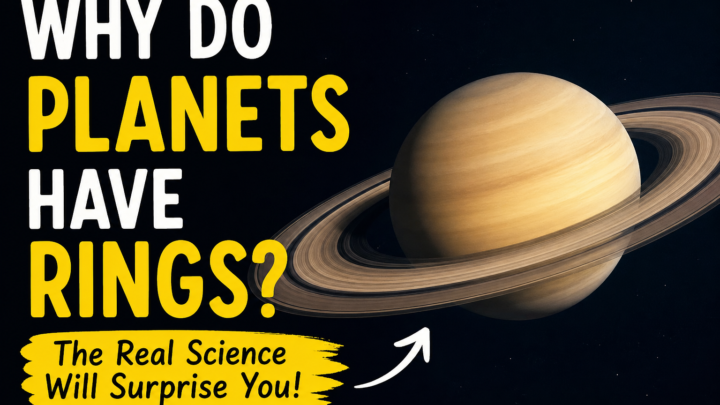
If you want a deeper planet-related explanation, you can also read our guide on why planets have rings, because planetary systems often behave in ways that look simple from far away but become much stranger when you study them closely.
/wp:paragraph
wp:heading
3. A day on Venus is longer than a year on Venus
/wp:heading
wp:paragraph
Venus gets even weirder.
/wp:paragraph
wp:paragraph
NASA’s Venus information explains that Venus takes about 243 Earth days to rotate once, but only about 225 Earth days to orbit the Sun. That means one day on Venus is longer than one year on Venus.
/wp:paragraph
wp:paragraph
Imagine waking up on Monday and having your birthday before the day is even over. That is basically the kind of strange timing Venus gives us.
/wp:paragraph
wp:paragraph
Another strange detail: Venus rotates in the opposite direction compared with most planets. So if you were somehow standing on Venus, the Sun would appear to rise in the west and set in the east.
/wp:paragraph
wp:paragraph
Of course, you would not survive standing there because Venus is extremely hot and has crushing atmospheric pressure, but the idea is still fascinating.
/wp:paragraph
wp:heading
4. The Moon is slowly moving away from Earth
/wp:heading
wp:paragraph
The Moon feels permanent. It rises, sets, changes phases, and lights up the night sky just like it always has.
/wp:paragraph
wp:paragraph
But it is not staying at the exact same distance.
/wp:paragraph
wp:paragraph
NASA explains that laser measurements using reflectors placed on the Moon show that the Moon is slowly moving away from Earth. The commonly cited rate is about 1.5 inches, or around 3.8 centimeters, per year.
/wp:paragraph
wp:paragraph
That sounds tiny, and for our daily lives, it is. But over millions of years, small changes become huge.
/wp:paragraph
wp:paragraph
This is one of those facts that makes space feel less static. Earth and the Moon are not frozen in place. They are part of a long gravitational relationship that is still changing.
/wp:paragraph
wp:heading
5. About 30 Earth-sized planets could fit between Earth and the Moon
/wp:heading
wp:paragraph
The Moon looks close because we can see it clearly. But space is usually much emptier than diagrams make it look.
/wp:paragraph
wp:paragraph
NASA gives the Moon’s average distance from Earth as about 238,855 miles, or 384,400 kilometers. At that distance, about 30 Earth-sized planets could fit between Earth and the Moon.
/wp:paragraph
wp:paragraph
That is a powerful scale check.
/wp:paragraph
wp:paragraph
Most textbook diagrams show the Moon near Earth because otherwise the page would look mostly empty. Real space is not like those neat diagrams. It is mostly distance.
/wp:paragraph
wp:paragraph
This is also why space travel is so difficult. Even our nearest natural neighbor is far away by normal human standards.
/wp:paragraph
wp:heading
6. The International Space Station orbits Earth about every 90 minutes
/wp:heading
wp:paragraph
The International Space Station does not simply “float” above us. It is moving extremely fast.
/wp:paragraph
wp:paragraph
NASA says the ISS travels around Earth at about 17,500 miles per hour and completes one orbit roughly every 90 minutes. That means astronauts aboard the ISS can see multiple sunrises and sunsets in a single Earth day.
/wp:paragraph
wp:paragraph
If you have never tried it, use NASA’s Spot the Station tool or a satellite tracking app. Seeing the ISS pass overhead as a bright moving point is one of the easiest ways to feel connected to space without needing a telescope.
/wp:paragraph
wp:paragraph
It does not blink like an airplane. It just glides across the sky quickly and quietly.
/wp:paragraph
wp:heading
7. Astronauts on the ISS are not floating because there is no gravity
/wp:heading
wp:paragraph
This is one of the most common space misunderstandings.
/wp:paragraph
wp:paragraph
Astronauts on the ISS float, but not because gravity has disappeared. Earth’s gravity is still acting on them. They float because the station and everything inside it are continuously falling around Earth together.
/wp:paragraph
wp:paragraph
That is what orbit is.
/wp:paragraph
wp:paragraph
A simple comparison is an elevator in free fall. If the elevator were falling and you were inside it, you would feel weightless for that moment. The ISS is doing something similar, except it is moving forward so fast that it keeps missing Earth as it falls.
/wp:paragraph
wp:paragraph
That is why scientists often use the term microgravity instead of zero gravity.
/wp:paragraph
wp:heading
8. NASA has confirmed more than 6,000 exoplanets
/wp:heading
wp:paragraph
For a long time, people wondered whether planets existed around other stars. Now we know they do.
/wp:paragraph
wp:paragraph
NASA’s exoplanet resources list more than 6,000 confirmed planets outside our solar system, and the count keeps growing as scientists confirm new worlds.
/wp:paragraph
wp:paragraph
That means when you look at the night sky, you are not just seeing stars. You are looking toward systems that may have planets of their own.
/wp:paragraph
wp:paragraph
Some are gas giants. Some are rocky. Some orbit very close to their stars. Some may exist in regions where temperatures could allow liquid water.
/wp:paragraph
wp:paragraph
This is one reason upcoming telescopes matter so much. Our article on the NASA Roman Space Telescope explains how future observatories may help scientists study more distant cosmic objects and large-scale structures.
/wp:paragraph
wp:heading
9. Some stars may already be gone by the time their light reaches us
/wp:heading
wp:paragraph
Looking at the night sky is also looking into the past.
/wp:paragraph
wp:paragraph
Light takes time to travel. The farther away a star or galaxy is, the older its light is when it reaches us.
/wp:paragraph
wp:paragraph
For nearby stars, the delay may be years or decades. For distant galaxies, the light may have been traveling for millions or billions of years.
/wp:paragraph
wp:paragraph
That means astronomy is not only about distance. It is also about time.
/wp:paragraph
wp:paragraph
When a telescope captures a faraway galaxy, it is not showing that galaxy exactly as it is “right now.” It is showing the light that left long ago.
/wp:paragraph
wp:paragraph
That idea never gets old.
/wp:paragraph
wp:heading
10. Black holes do not suck up everything like vacuum cleaners
/wp:heading
wp:paragraph
Movies often make black holes look like cosmic vacuum cleaners. That is not accurate.
/wp:paragraph
wp:paragraph
A black hole has strong gravity, but it does not automatically suck in everything in the universe. If the Sun were somehow replaced by a black hole with the same mass, Earth would not instantly fall in. It would keep orbiting because the gravitational pull at Earth’s distance would be similar.
/wp:paragraph
wp:paragraph
The danger comes when something gets too close.
/wp:paragraph
wp:paragraph
NASA’s black hole basics explain that black holes are huge concentrations of matter packed into very small spaces. Their gravity near the event horizon is so strong that not even light can escape.
/wp:paragraph
wp:paragraph
If black holes interest you, read our separate guide on what would happen if you fell into a black hole. It explains the experience in a more focused way.
/wp:paragraph
wp:heading
11. Black holes can stretch matter like spaghetti
/wp:heading
wp:paragraph
This sounds like a joke, but it is real science. The process is often called spaghettification.
/wp:paragraph
wp:paragraph
Near a black hole, gravity can be much stronger on one side of an object than the other. If your feet were closer to the black hole than your head, your feet would feel a stronger pull. That difference can stretch matter vertically and squeeze it sideways.
/wp:paragraph
wp:paragraph
NASA describes spaghettification as matter being squeezed horizontally and stretched vertically when it gets too close to a black hole.
/wp:paragraph
wp:paragraph
The name is funny. The effect is not.
/wp:paragraph
wp:paragraph
This is one of the easiest black hole ideas to explain because it comes down to uneven gravity. The object is not pulled equally from every side. That difference becomes destructive near extreme gravity.
/wp:paragraph
wp:heading
12. A black hole’s event horizon is a point of no return
/wp:heading
wp:paragraph
The event horizon is the boundary around a black hole where escape becomes impossible.
/wp:paragraph
wp:paragraph
Once something crosses it, it cannot send light or information back out in a normal way. That is why black holes are so mysterious. We can study their effects, but we cannot directly see what happens inside the event horizon.
/wp:paragraph
wp:paragraph
NASA has created a black hole visualization that helps people imagine what it would look like to approach a black hole. These visual tools are useful because black holes bend light in ways that normal experience cannot prepare us for.
/wp:paragraph
wp:paragraph
A simple way to imagine the event horizon is a river approaching a waterfall. Far away, you can paddle back. Too close, the current wins.
/wp:paragraph
wp:heading
13. Black holes can spin incredibly fast
/wp:heading
wp:paragraph
Black holes are not just dark, silent holes sitting still in space. They can spin.
/wp:paragraph
wp:paragraph
NASA explains that all black holes spin, and one of the fastest-known examples, GRS 1915+105, rotates more than 1,000 times per second.
/wp:paragraph
wp:paragraph
That number is hard to picture.
/wp:paragraph
wp:paragraph
A kitchen blender sounds fast. A car engine sounds fast. But a black hole spinning hundreds or thousands of times per second is on a completely different scale.
/wp:paragraph
wp:paragraph
This is why black holes are such powerful topics for science writers. They are not only strange objects. They test the limits of physics.
/wp:paragraph
wp:heading
14. A teaspoon of neutron-star material would be unbelievably heavy
/wp:heading
wp:paragraph
A neutron star is what can remain after a massive star explodes and its core collapses.
/wp:paragraph
wp:paragraph
NASA explains that neutron stars can pack more mass than the Sun into a sphere roughly the size of a city. Some NASA educational material compares a teaspoon of neutron-star material to the mass of Mount Everest.
/wp:paragraph
wp:paragraph
That comparison is hard to absorb.
/wp:paragraph
wp:paragraph
On Earth, heavy things are usually large: buildings, trucks, mountains. Neutron stars break that intuition. They show what happens when matter is crushed into extreme density.
/wp:paragraph
wp:paragraph
If you want one space fact that makes normal life feel tiny, this is it.
/wp:paragraph
wp:heading
15. Mars has the largest volcano in the solar system
/wp:heading
wp:paragraph
Mars may look quiet today, but it has some extreme geography.
/wp:paragraph
wp:paragraph
Olympus Mons on Mars is the largest volcano in the solar system. NASA says it stands more than 25 miles, or over 40 kilometers, tall from base to summit, with a base covering an area as large as Arizona.
/wp:paragraph
wp:paragraph
That is much taller than Mount Everest.
/wp:paragraph
wp:paragraph
The surprising part is that Olympus Mons is also incredibly wide. If you stood on parts of it, the slope might not feel as steep as you imagine because the volcano spreads across such a huge area.
/wp:paragraph
wp:paragraph
For more about how scientists study Mars, read our guide on how NASA maps the surface of Mars.
/wp:paragraph
wp:heading
16. The asteroid belt is not packed like movie scenes show
/wp:heading
wp:paragraph
In science fiction, asteroid belts often look like dangerous obstacle courses. Spaceships dodge rocks every few seconds.
/wp:paragraph
wp:paragraph
Real asteroid belts are not like that.
/wp:paragraph
wp:paragraph
The asteroid belt contains many objects, but space is enormous, and the objects are spread out across a huge region. Spacecraft have passed through the asteroid belt many times without needing movie-style flying.
/wp:paragraph
wp:paragraph
This is a common mistake: movies compress space to make scenes exciting.
/wp:paragraph
wp:paragraph
Real space is dramatic in a quieter way. It is mostly emptiness, interrupted by planets, moons, dust, rocks, stars, and radiation.
/wp:paragraph
wp:heading
17. The universe has a leftover glow from its early history
/wp:heading
wp:paragraph
The cosmic microwave background is sometimes described as leftover radiation from the early universe.
/wp:paragraph
wp:paragraph
NASA’s WMAP mission studied tiny temperature variations in this ancient background glow. It is one of the most important pieces of evidence scientists use to understand the early universe.
/wp:paragraph
wp:paragraph
What makes this strange is that the universe still carries a faint signal from its early hot state.
/wp:paragraph
wp:paragraph
It is not visible to our eyes, but instruments can detect it.
/wp:paragraph
wp:paragraph
That is one reason astronomy depends so heavily on technology. Human eyes are amazing, but they only see a narrow part of what the universe is doing.
/wp:paragraph
wp:heading
18. Space is not completely empty
/wp:heading
wp:paragraph
People often imagine space as pure emptiness.
/wp:paragraph
wp:paragraph
It is mostly empty compared with Earth’s atmosphere, but it is not absolute nothingness. Space contains particles, dust, radiation, magnetic fields, gas, and cosmic rays.
/wp:paragraph
wp:paragraph
Even the space between planets is affected by the solar wind coming from the Sun.
/wp:paragraph
wp:paragraph
This matters because “empty space” can still damage spacecraft, affect communication, and shape planetary environments.
/wp:paragraph
wp:paragraph
So when someone says space is empty, the better answer is: almost, but not completely.
/wp:paragraph
wp:heading
19. Voyager 1 and Voyager 2 are in interstellar space
/wp:heading
wp:paragraph
Voyager 1 and Voyager 2 launched in 1977. Decades later, both entered interstellar space.
/wp:paragraph
wp:paragraph
NASA says Voyager 1 reached interstellar space in 2012, and Voyager 2 followed in 2018. Both continue their unique journeys deeper into space.
/wp:paragraph
wp:paragraph
That fact feels almost emotional.
/wp:paragraph
wp:paragraph
These spacecraft were built with 1970s technology, yet they are still traveling away from the Sun. They carry human engineering, mission planning, and the famous Golden Records into deep space.
/wp:paragraph
wp:paragraph
It is one of the best reminders that space exploration is not always about the newest rocket. Sometimes it is about a well-built machine that keeps going.
/wp:paragraph
wp:heading
20. Sunlight takes about 8 minutes to reach Earth
/wp:heading
wp:paragraph
When sunlight reaches your face, it is already about 8 minutes old.
/wp:paragraph
wp:paragraph
That is because light takes time to travel from the Sun to Earth. The Sun is close compared with other stars, but even that distance is huge by everyday standards.
/wp:paragraph
wp:paragraph
This fact is simple but powerful. It shows that even ordinary sunlight connects us to cosmic distance.
/wp:paragraph
wp:paragraph
When you watch a sunset, you are not seeing the Sun exactly as it is at that instant. You are seeing light that left minutes earlier.
/wp:paragraph
wp:heading
21. Jupiter is almost like a mini solar system
/wp:heading
wp:paragraph
Jupiter is not just a big planet. It has many moons, powerful storms, strong radiation belts, and a massive magnetic field.
/wp:paragraph
wp:paragraph
Its four large Galilean moons — Io, Europa, Ganymede, and Callisto — are especially interesting. Io is volcanic. Europa may have a subsurface ocean. Ganymede is the largest moon in the solar system.
/wp:paragraph
wp:paragraph
Jupiter feels almost like a mini solar system because so many objects and processes are happening around it.
/wp:paragraph
wp:paragraph
This is also why Jupiter is so important in planetary science. It is not only one planet; it is a whole environment.
/wp:paragraph
wp:heading
22. Saturn’s rings are wide but surprisingly thin
/wp:heading
wp:paragraph
Saturn’s rings look huge in photos, and they are huge in width. But compared with how wide they are, they are very thin.
/wp:paragraph
wp:paragraph
They are not a solid disk either. They are made of countless icy particles, rocks, and dust orbiting Saturn.
/wp:paragraph
wp:paragraph
This is another place where space images can mislead us. From far away, the rings look smooth. In reality, they are made of many pieces.
/wp:paragraph
wp:paragraph
If you want a deeper explanation, read our article on why planets have rings.
/wp:paragraph
wp:heading
23. Some planets may not orbit stars at all
/wp:heading
wp:paragraph
Most people think of planets as objects orbiting stars. Earth orbits the Sun, so that seems normal.
/wp:paragraph
wp:paragraph
But astronomers have found evidence for rogue planets, which are planets that drift through space without being tied to a star.
/wp:paragraph
wp:paragraph
These worlds may be cold, dark, and extremely hard to detect.
/wp:paragraph
wp:paragraph
The idea feels lonely: a planet moving through the galaxy without sunrise, sunset, or seasons like ours.
/wp:paragraph
wp:paragraph
It also reminds us that our solar system is only one type of planetary arrangement. The universe is much more varied.
/wp:paragraph
wp:heading
24. Earth is moving in several ways at once
/wp:heading
wp:paragraph
Right now, you may feel still. But you are not.
/wp:paragraph
wp:paragraph
Earth is rotating. Earth is orbiting the Sun. The Sun is moving around the center of the Milky Way. The Milky Way itself is moving through space.
/wp:paragraph
wp:paragraph
We do not feel these motions because they are steady from our perspective.
/wp:paragraph
wp:paragraph
This is one of those space facts that becomes more interesting when you use a sky app for a few nights. Planets shift. Constellations appear in different positions. The sky is not a fixed ceiling. It is a changing view from a moving planet.
/wp:paragraph
wp:heading
25. The strangest space fact may be that we can understand any of this
/wp:heading
wp:paragraph
This may sound less dramatic than black holes or neutron stars, but it might be the strangest fact of all.
/wp:paragraph
wp:paragraph
Humans live on a small planet around an ordinary star. Yet we have built telescopes, spacecraft, satellites, detectors, apps, simulations, and observatories that help us understand objects millions or billions of light-years away.
/wp:paragraph
wp:paragraph
You can open a phone app and identify Jupiter. You can track the ISS. You can read NASA mission updates. You can explore exoplanet catalogs. You can watch real spacecraft data and images from Mars.
/wp:paragraph
wp:paragraph
That is strange in the best way.
/wp:paragraph
wp:paragraph
The universe is enormous, but we are not completely blind inside it.
/wp:paragraph
wp:heading
How to Explore These Space Facts Yourself
/wp:heading
wp:paragraph
If you want these facts to feel real, do not only read them. Try exploring them with simple tools.
/wp:paragraph
wp:paragraph
Start with a sky map app such as Stellarium, Sky Tonight, Star Walk, or a similar planetarium app. Open it at night and point it toward the Moon or a bright planet. Jupiter, Venus, Mars, and Saturn are usually easier to recognize than faint stars.
/wp:paragraph
wp:paragraph
Next, use NASA’s official pages when you read about planets, black holes, the Moon, or missions. Social media posts often simplify facts too much. NASA pages are not always the shortest, but they are safer for accuracy.
/wp:paragraph
wp:paragraph
Then try NASA’s Spot the Station tool. Seeing the ISS pass overhead is one of the easiest real-life space experiences. You do not need expensive equipment.
/wp:paragraph
wp:paragraph
Finally, when you read a large number, compare it with something familiar. Do not just read “17,500 miles per hour.” Think: the ISS goes around Earth in about 90 minutes. Do not just read “30 Earths fit between Earth and the Moon.” Picture how wrong most textbook diagrams are.
/wp:paragraph
wp:paragraph
That is how space facts become easier to remember.
/wp:paragraph
wp:heading
Common Mistakes People Make With Space Facts
/wp:heading
wp:paragraph
The first mistake is believing every dramatic space post online. If a post says “NASA found another Earth” or “a black hole is coming toward us,” check the source before sharing it.
/wp:paragraph
wp:paragraph
The second mistake is treating space images like normal camera photos. Many space images use infrared, X-ray, radio, or processed color data. That does not make them fake. It means scientists are showing information our eyes cannot normally see.
/wp:paragraph
wp:paragraph
The third mistake is thinking black holes suck up everything nearby. They are powerful, but they follow gravity. They are not magic space vacuums.
/wp:paragraph
wp:paragraph
The fourth mistake is using space facts without context. A fact may be technically true but misleading if the explanation is missing. That is why good science writing should explain the “why,” not just the number.
/wp:paragraph
wp:heading
Frequently Asked Questions About Space Facts
/wp:heading
wp:heading {“level”:3}
What is the most surprising fact about space?
/wp:heading
wp:paragraph
One of the most surprising space facts is that the Sun contains almost all the mass in our solar system. The planets look important in diagrams, but the Sun holds about 99.8% of the solar system’s mass, which means it dominates the entire system gravitationally.
/wp:paragraph
wp:heading {“level”:3}
Why is space so strange?
/wp:heading
wp:paragraph
Space feels strange because it does not behave like everyday life on Earth. Distances are enormous, gravity can bend light, stars can collapse into black holes, and time itself can be affected by extreme gravity and speed. Many space facts sound unbelievable at first because our daily experience is too small to prepare us for cosmic scales.
/wp:paragraph
wp:heading {“level”:3}
Is space completely empty?
/wp:heading
wp:paragraph
No, space is not completely empty. It is mostly empty compared with Earth’s atmosphere, but it still contains particles, dust, radiation, magnetic fields, gas, cosmic rays, and light. Even the space between planets is affected by the solar wind coming from the Sun.
/wp:paragraph
wp:heading {“level”:3}
Why is Venus hotter than Mercury?
/wp:heading
wp:paragraph
Venus is hotter than Mercury because Venus has a thick atmosphere that traps heat extremely well. Mercury is closer to the Sun, but it has almost no atmosphere to hold heat. Venus acts more like a heat trap, which is why it has the hottest planetary surface in the solar system.
/wp:paragraph
wp:heading {“level”:3}
Can black holes suck up the whole universe?
/wp:heading
wp:paragraph
No, black holes do not suck up everything like vacuum cleaners. A black hole has gravity, but its pull depends on distance and mass, just like other objects. If something stays far enough away, it can orbit or pass by without falling in. The danger begins when matter gets too close to the black hole’s event horizon.
/wp:paragraph
wp:heading {“level”:3}
What happens if you fall into a black hole?
/wp:heading
wp:paragraph
If you fell into a black hole, the result would depend on the size of the black hole. Near smaller black holes, the difference in gravity between your head and feet could stretch you apart in a process called spaghettification. Near a supermassive black hole, the process may be different at first, but once you cross the event horizon, escape would be impossible. You can read the full explanation in our guide on what happens if you fall into a black hole.
/wp:paragraph
wp:heading {“level”:3}
Why does the Moon move away from Earth?
/wp:heading
wp:paragraph
The Moon is slowly moving away because of tidal interactions between Earth and the Moon. Earth’s rotation and the Moon’s gravity affect each other over time. The movement is very slow, so it does not change daily life, but over millions of years, the distance becomes meaningful.
/wp:paragraph
wp:heading {“level”:3}
How many planets have been found outside our solar system?
/wp:heading
wp:paragraph
Scientists have confirmed more than 6,000 planets outside our solar system. These planets are called exoplanets. Some are giant gas planets, some are rocky, and some orbit in regions where temperatures might allow liquid water. Exoplanet discoveries show that planets are common around other stars.
/wp:paragraph
wp:heading {“level”:3}
Why do astronauts float in space?
/wp:heading
wp:paragraph
Astronauts on the International Space Station float because they are in continuous free fall around Earth. Gravity has not disappeared. The station and everything inside it are falling together while moving forward fast enough to keep orbiting Earth. That creates the feeling of weightlessness.
/wp:paragraph
wp:heading {“level”:3}
Are all space images real?
/wp:heading
wp:paragraph
Space images are usually based on real data, but many are processed to show details humans cannot see with normal eyes. Telescopes may collect infrared, ultraviolet, X-ray, radio, or other types of data. Scientists often use color processing to make those invisible details understandable. That does not mean the image is fake; it means the image is helping us see hidden information.
/wp:paragraph
wp:heading {“level”:3}
What is the best way to learn space facts?
/wp:heading
wp:paragraph
The best way is to combine simple reading with real tools. Use a sky map app to identify planets, check NASA pages for accurate information, track the International Space Station, and compare big numbers with real-life examples. Space facts become easier to remember when you connect them with something you can actually see or imagine.
/wp:paragraph
wp:heading {“level”:3}
Are space facts good for kids and beginners?
/wp:heading
wp:paragraph
Yes, space facts are great for kids and beginners because they make science interesting without requiring advanced math. The key is to explain the reason behind each fact. A simple fact like “Venus is hotter than Mercury” becomes much more useful when you explain that Venus has a thick heat-trapping atmosphere.
/wp:paragraph
wp:heading
Final Thoughts
/wp:heading
wp:paragraph
Space facts are fun, but the best ones do more than surprise you. They change the way you imagine reality.
/wp:paragraph
wp:paragraph
The Sun holds almost the whole mass of the solar system. Venus has a day longer than its year. The Moon is slowly moving away. The ISS circles Earth about every 90 minutes. Black holes stretch matter. Neutron stars crush mass into unbelievable density. Voyager spacecraft are still traveling beyond the Sun’s influence.
/wp:paragraph
wp:paragraph
And somehow, from a small planet, we can study all of it.
/wp:paragraph
wp:paragraph
That is what makes space so addictive to learn about. Every answer opens another strange question.
/wp:paragraph
wp:heading
Sources and Further Reading
/wp:heading
wp:paragraph
NASA Sun Facts: NASA’s Sun facts
NASA Venus Facts: NASA’s Venus facts
NASA Moon Facts: NASA Moon facts
NASA ISS Tracking: Spot the Station
NASA Exoplanets: NASA Exoplanets
NASA Black Holes: NASA black hole basics
NASA Mars Facts: NASA Mars facts
NASA Voyager Mission: NASA Voyager mission
/wp:paragraph
wp:paragraph
/wp:paragraph