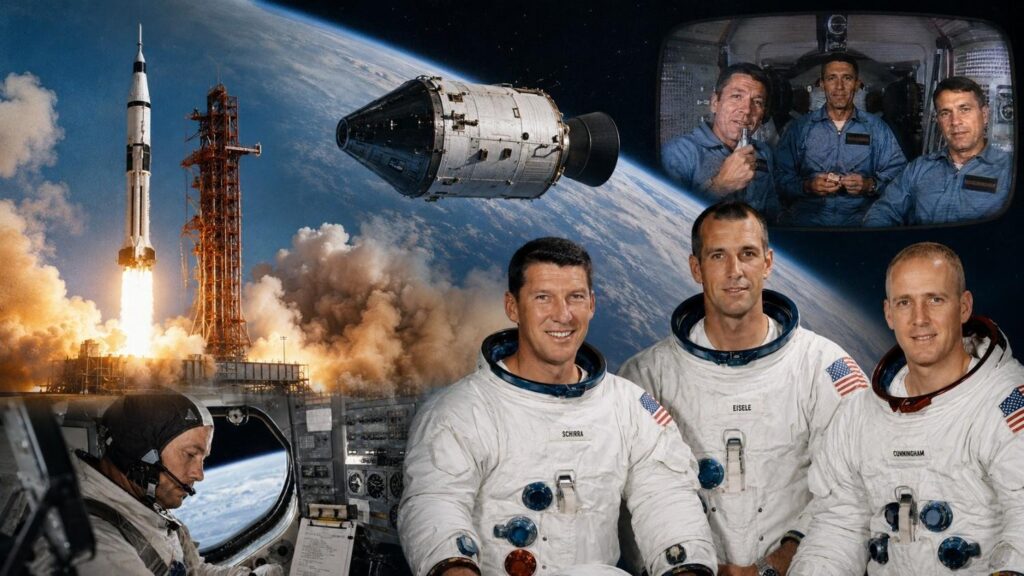
In October 1968, the Apollo program was not just chasing the Moon. It was trying to recover from tragedy.
/wp:paragraph wp:paragraphLess than two years earlier, three astronauts — Gus Grissom, Ed White, and Roger Chaffee — had died in the Apollo 1 fire during a ground test. The accident shook NASA, the American public, and the future of the Moon program. Engineers redesigned the spacecraft. Safety procedures changed. Materials were reviewed. The program moved forward, but one question still mattered more than anything else: could NASA safely fly astronauts in Apollo again?
/wp:paragraph wp:paragraphThen Apollo 7 reached orbit.
/wp:paragraph wp:paragraphInside a small command module circling Earth, Wally Schirra, Donn Eisele, and Walt Cunningham became the first crew to fly an Apollo spacecraft. About 72 hours into the mission, they aimed a small black-and-white television camera inside the cabin and sent live pictures back to Earth. For the first time, Americans could watch astronauts live from an American spacecraft in orbit. NASA’s history office confirms that the first live TV broadcast from an American spacecraft happened during Apollo 7 and had to be timed with ground-station coverage over the United States. NASA History: Live from the Apollo Room
/wp:paragraph wp:paragraphThat moment made Apollo 7 more than a test flight. The Apollo 7 first live TV broadcast from space milestone helped people see human spaceflight in a new way. It also proved that Apollo was no longer only recovering from Apollo 1. It was moving forward.
/wp:paragraph wp:gallery {“linkTo”:”none”}
For the full story of the Apollo sequence, readers can also explore Apollo 1 Fire Explained: The Tragedy That Changed NASA Safety, Apollo 8: First Mission to Orbit the Moon, and Apollo 11 Moon Landing Explained.
/wp:paragraph wp:headingAccuracy note
/wp:heading wp:paragraphThis article explains Apollo 7 as a confirmed historical NASA mission. Apollo 7 did not land on the Moon and did not orbit the Moon. It was an Earth-orbital test flight of the Apollo Command and Service Module.
/wp:paragraph wp:paragraphThis article uses official NASA, Smithsonian National Air and Space Museum, and Lunar and Planetary Institute sources. It avoids unsupported claims, alien speculation, and exaggerated language. The goal is to explain why Apollo 7 mattered historically, technically, and emotionally.
/wp:paragraph wp:headingKey Facts About Apollo 7
/wp:heading wp:table| Key Detail | Confirmed Information |
|---|---|
| Mission | Apollo 7 |
| Launch date | October 11, 1968 |
| Launch vehicle | Saturn IB |
| Crew | Walter M. “Wally” Schirra Jr., Donn F. Eisele, R. Walter Cunningham |
| Mission type | Crewed Earth-orbital test of the Command and Service Module |
| Main broadcast milestone | First live TV broadcast from an American spacecraft |
| Broadcast nickname | “The Walt, Wally and Donn Show” |
| Mission duration | About 10 days and 20 hours |
| Earth orbits | 163 |
| Historical role | First crewed Apollo mission after the Apollo 1 tragedy |
NASA identifies Apollo 7 as the first crewed Apollo space mission and records it as an Earth-orbital Command and Service Module test flight crewed by Schirra, Eisele, and Cunningham. NASA: About Apollo 7 The Smithsonian National Air and Space Museum notes that the crew orbited Earth 163 times and spent 10 days and 20 hours in space. Smithsonian: Apollo 7
/wp:paragraph wp:headingWhy Apollo 7 Was More Than a Test Flight
/wp:heading wp:paragraphApollo 7 is sometimes overshadowed by Apollo 8 and Apollo 11. That is understandable. Apollo 8 carried astronauts around the Moon. Apollo 11 landed astronauts on the lunar surface.
/wp:paragraph wp:paragraphApollo 7 did neither.
/wp:paragraph wp:paragraphBut Apollo 7 did something NASA urgently needed: it proved that Apollo could fly safely with a crew again. The mission tested the redesigned Apollo Command and Service Module in Earth orbit before NASA attempted more complex lunar missions. The Lunar and Planetary Institute describes Apollo 7’s principal objective as thoroughly testing the Command and Service Module systems in preparation for later missions. Lunar and Planetary Institute: Apollo 7 Mission Overview
/wp:paragraph wp:paragraphThat made Apollo 7 a bridge mission. It connected the tragedy of Apollo 1 with the success of later Apollo flights. Without Apollo 7, NASA would have had far less confidence to move quickly toward Apollo 8’s lunar orbit mission and Apollo 11’s Moon landing.
/wp:paragraph wp:paragraphFor readers who want the full sequence, this article fits naturally with The Complete Apollo Program Timeline.
/wp:paragraph wp:headingThe Shadow of Apollo 1
/wp:heading wp:paragraphTo understand Apollo 7, you have to understand Apollo 1.
/wp:paragraph wp:paragraphApollo 1 was planned as the first crewed Apollo mission, but it never launched. On January 27, 1967, during a preflight test at Cape Kennedy, a fire broke out inside the command module. Astronauts Virgil “Gus” Grissom, Edward White, and Roger Chaffee died in the accident. NASA records Apollo 1 as the mission that ended in tragedy during a launch-pad test before its planned February 1967 flight. NASA: Apollo 1
/wp:paragraph wp:paragraphThe accident forced NASA to reconsider spacecraft safety. The Apollo command module was redesigned. Fire risk was reduced. Materials were reviewed. The hatch and emergency escape concerns became central lessons. Testing and procedures changed.
/wp:paragraph wp:paragraphApollo 7 was the first crewed opportunity to prove those changes in space. Smithsonian describes Apollo 7 as the first test of the new Block II Command and Service Module in orbit after the Apollo 1 fire. Smithsonian: Apollo 7
/wp:paragraph wp:paragraphThis is why Apollo 7 carried so much pressure. It was not just another mission. It was NASA asking, in front of the world, whether Apollo was ready to fly humans again.
/wp:paragraph wp:paragraphFor more background on the tragedy that shaped this mission, read Apollo 1 Fire Explained: The Tragedy That Changed NASA Safety.
/wp:paragraph wp:headingThe Crew: Wally Schirra, Donn Eisele, and Walt Cunningham
/wp:heading wp:paragraphApollo 7 had a three-person crew.
/wp:paragraph wp:paragraphWally Schirra was the commander. He was already an experienced astronaut, having flown in Mercury and Gemini before Apollo. His presence gave Apollo 7 an experienced leader during a difficult return-to-flight mission.
/wp:paragraph wp:paragraphDonn Eisele served as Command Module Pilot. His work focused on spacecraft systems, navigation, and mission operations inside the command module.
/wp:paragraph wp:paragraphWalt Cunningham served as Lunar Module Pilot, even though Apollo 7 did not carry a Lunar Module. That title can confuse readers, but it was part of the Apollo crew-role structure. On Apollo 7, Cunningham supported spacecraft operations and mission tasks inside the command module.
/wp:paragraph wp:paragraphNASA’s Apollo 7 page identifies Schirra, Eisele, and Cunningham as the crew of the first crewed Apollo mission. NASA: Apollo 7 Mission Page
/wp:paragraph wp:paragraphFor a deeper profile article, Sanceen can later link this section to Who Were the Apollo 7 Astronauts?.
/wp:paragraph wp:headingLaunch Day: America Returns to Crewed Apollo Flight
/wp:heading wp:paragraphApollo 7 launched on October 11, 1968, from Launch Complex 34 at Cape Kennedy. NASA describes the launch as a successful Saturn IB flight with Schirra, Eisele, and Cunningham aboard, marking the first trial launch of Saturn IB with humans. NASA: About Apollo 7
/wp:paragraph wp:image {“id”:680,”sizeSlug”:”large”,”linkDestination”:”none”}
The launch mattered because it was the first crewed Apollo flight after Apollo 1. A successful launch was the first visible sign that Apollo was back in motion.
/wp:paragraph wp:paragraphBut launch was only the beginning. Apollo 7 still had to survive days of testing in orbit. The spacecraft had to prove it could support a crew. Mission Control had to prove it could manage a long Apollo flight. Communications had to work. Navigation had to work. The propulsion system had to perform.
/wp:paragraph wp:paragraphIf Apollo 7 failed, the road to the Moon would become much longer.
/wp:paragraph wp:headingWhat Apollo 7 Had to Prove
/wp:heading wp:paragraphApollo 7’s job was practical, not glamorous. NASA needed to test the spacecraft that would later carry astronauts toward the Moon.
/wp:paragraph wp:paragraphThe Command Module was the crew’s living and control area. The Service Module carried major support systems, including propulsion, power, and other spacecraft functions. Together, the Command and Service Module had to perform reliably before NASA could risk sending astronauts farther from Earth.
/wp:paragraph wp:paragraphApollo 7 tested:
/wp:paragraph wp:paragraphCrew operations inside the Apollo spacecraft
Command and Service Module performance
Spacecraft propulsion and maneuvering
Navigation and guidance systems
Mission Control support
Earth-orbital operations
Rendezvous-related procedures
Voice, telemetry, and television communication
NASA’s Apollo 7 mission description says the mission objectives included demonstrating Command and Service Module performance, crew performance, mission support facilities, rendezvous capability, and live TV broadcasts from space. NASA: About Apollo 7
/wp:paragraph wp:paragraphThis was the engineering foundation for future Apollo missions. Apollo 7 did not need to be dramatic. It needed to be reliable.
/wp:paragraph wp:paragraphFor more on mission operations, a useful supporting article would be How NASA’s Mission Control Works.
/wp:paragraph wp:headingApollo 7 First Live TV Broadcast From Space: What Actually Happened?
/wp:heading wp:paragraphAbout 72 hours into Apollo 7, the crew made television history.
/wp:paragraph wp:paragraphNASA’s history office explains that the first live TV broadcast from an American spacecraft happened during Apollo 7 and had to be carefully timed with spacecraft passes over the continental United States. Only ground stations at Corpus Christi, Texas, and Merritt Island, Florida, had the necessary equipment to receive the signals and convert them for broadcast. NASA History: Live from the Apollo Room
/wp:paragraph wp:paragraphThat detail is important.
/wp:paragraph wp:paragraphThis was not a modern livestream. There was no YouTube, no social media, no high-definition space camera, and no global internet replay. The spacecraft had to pass over the right region at the right time. Ground stations had to receive the signal. The signal then had to be converted into a form that television networks could use.
/wp:paragraph wp:paragraphFor viewers in 1968, the result was extraordinary. They were watching astronauts live from orbit.
/wp:paragraph wp:image {“id”:681,”sizeSlug”:”large”,”linkDestination”:”none”}
This section also connects naturally with Sanceen’s modern space communication content, including NASA Deep Space Laser Communication and How NASA Broadcasts Spaceflight From Orbit.
/wp:paragraph wp:headingWhat Viewers Saw During the Historic 1968 Broadcast
/wp:heading wp:paragraphThe Apollo 7 broadcasts were informal, human, and sometimes playful.
/wp:paragraph wp:paragraphNASA remembers the broadcasts as “The Walt, Wally and Donn Show,” using the crew’s names: Walt Cunningham, Wally Schirra, and Donn Eisele. NASA: About Apollo 7 During the first broadcast, the astronauts appeared inside the spacecraft and used cue cards, including the phrase “From the Lovely Apollo Room High Atop Everything.” NASA History: Live from the Apollo Room
/wp:paragraph wp:paragraphThat may sound lighthearted, but it mattered.
/wp:paragraph wp:paragraphPeople on Earth were no longer only reading reports or listening to radio updates. They could see the astronauts inside the spacecraft. They could watch them move in microgravity. They could see that human beings were living and working in orbit.
/wp:paragraph wp:paragraphThe broadcast made Apollo feel closer.
/wp:paragraph wp:paragraphIt helped ordinary viewers understand that human spaceflight was not only a technical project. It was also a human experience: cramped, difficult, risky, and deeply real.
/wp:paragraph wp:headingHow 1968 TV Technology Worked in Space
/wp:heading wp:paragraphBy today’s standards, the Apollo 7 camera was simple. By 1968 standards, it was historic.
/wp:paragraph wp:paragraphThe Smithsonian National Air and Space Museum identifies the Apollo 7 television camera as an RCA black-and-white camera with a 100mm wide-angle lens. Smithsonian states that this camera and lens were part of the first television broadcast from space during Apollo 7. Smithsonian: Apollo 7 Television Camera
/wp:paragraph wp:paragraphThe camera did not produce the kind of image quality modern audiences expect. It was black-and-white, limited, and dependent on ground-station coverage. But it opened a new era in space communication.
/wp:paragraph wp:paragraphToday, live video from space feels normal. Astronauts can speak to classrooms from orbit. Spacewalks are broadcast live. Rocket launches are streamed around the world. Future missions may send high-resolution data using advanced optical communication systems.
/wp:paragraph wp:paragraphApollo 7 was an early step in that larger story.
/wp:paragraph wp:paragraphFor modern context, link here to NASA Deep Space Laser Communication and NASA Next-Gen Space Telescopes Tech 2026.
/wp:paragraph wp:headingWhy the Broadcast Helped NASA
/wp:heading wp:paragraphThe broadcast helped NASA in three major ways.
/wp:paragraph wp:paragraphFirst, it brought the public inside the spacecraft. Apollo was no longer only a rocket on a launch pad or a voice from Mission Control. It was a crew of people living and working above Earth.
/wp:paragraph wp:paragraphSecond, it demonstrated that the Apollo spacecraft could support more than basic voice contact. Later Apollo missions would depend on communication for navigation, crew support, engineering data, public coverage, and mission safety.
/wp:paragraph wp:paragraphThird, it helped rebuild public confidence after Apollo 1. Seeing Schirra, Eisele, and Cunningham live from orbit gave viewers a powerful signal that NASA had recovered enough to fly humans again.
/wp:paragraph wp:paragraphThis is why the Apollo 7 television moment should not be treated as a small media trick. It was part of the mission’s emotional and technical success.
/wp:paragraph wp:headingLife Inside Apollo 7
/wp:heading wp:paragraphApollo 7 was successful, but it was not comfortable.
/wp:paragraph wp:paragraphAll three astronauts developed head colds during the mission. Smithsonian notes that the only significant difficulty during Apollo 7 was that all three crew members developed severe head colds. Smithsonian: Apollo 7
/wp:paragraph wp:paragraphA cold in space can be miserable. In microgravity, fluids do not drain the same way they do on Earth. Congestion can feel worse. Sleep, communication, and workload can become more stressful.
/wp:paragraph wp:paragraphThe mission also became known for tense exchanges between the crew and Mission Control. Apollo 7 was technically successful, but the experience inside the spacecraft was demanding.
/wp:paragraph wp:image {“id”:682,”sizeSlug”:”large”,”linkDestination”:”none”}
This human side matters. Apollo 7 was not a smooth public-relations show. It was a difficult test flight completed under pressure by a crew that was tired, uncomfortable, and responsible for proving the Apollo spacecraft could work.
/wp:paragraph wp:headingApollo 7 vs Apollo 8 vs Apollo 11
/wp:heading wp:paragraphApollo 7 is sometimes overlooked because Apollo 8 and Apollo 11 are more famous. But the sequence is what makes Apollo history meaningful.
/wp:paragraph wp:table| Mission | Main Goal | Why It Mattered |
|---|---|---|
| Apollo 1 | Planned first crewed Apollo flight; never flew | Led to major redesign after the fatal 1967 fire |
| Apollo 7 | Crewed Earth-orbital test of the Command and Service Module | Proved Apollo could fly humans again and broadcast live from orbit |
| Apollo 8 | First crewed mission to orbit the Moon | Proved Apollo could reach and orbit the Moon |
| Apollo 11 | First crewed Moon landing | Achieved NASA’s goal of landing astronauts on the lunar surface |
Apollo 7 stayed in Earth orbit. Apollo 8 went to lunar orbit. Apollo 11 landed on the Moon.
/wp:paragraph wp:paragraphBut Apollo 8 and Apollo 11 depended on confidence built by Apollo 7. The best reader journey for this topic is: Apollo 1 Fire Explained → Apollo 7 → Apollo 8: First Mission to Orbit the Moon → Apollo 11 Moon Landing Explained.
/wp:paragraph wp:headingThe Mission Results
/wp:heading wp:paragraphApollo 7 completed 163 orbits of Earth and lasted about 10 days and 20 hours. Smithsonian records the mission’s 163 Earth orbits and 10-day, 20-hour duration, while NASA identifies the mission as the first crewed Apollo flight that paved the way for the Moon landing less than a year later. Smithsonian: Apollo 7
/wp:paragraph wp:image {“id”:683,”sizeSlug”:”large”,”linkDestination”:”none”}
The mission proved several important things.
/wp:paragraph wp:paragraphThe redesigned Apollo spacecraft could support a crew. The Command and Service Module systems worked in orbit. Mission Control could manage a long Apollo mission. The crew could operate the spacecraft for an extended period. Live television from an American spacecraft was possible.
/wp:paragraph wp:paragraphApollo 7 gave NASA the confidence it needed to move ahead.
/wp:paragraph wp:headingWhy This Matters Today
/wp:heading wp:paragraphApollo 7 still matters because modern spaceflight depends on the same basic ideas: safety, testing, communication, trust, and public connection.
/wp:paragraph wp:paragraphToday, people expect to watch rocket launches live. They expect spacecraft cameras, astronaut interviews, mission updates, and real-time space coverage. NASA, SpaceX, ESA, JAXA, and other space organizations regularly use live video to make space missions visible to the public.
/wp:paragraph wp:paragraphApollo 7 helped begin that public connection.
/wp:paragraph wp:paragraphWhen Americans watched astronauts live from orbit in 1968, they were seeing an early version of something that is now normal: space exploration as a shared live experience. The technology has changed enormously, but the idea remains the same. People connect more deeply with spaceflight when they can see it happening.
/wp:paragraph wp:paragraphThat is why Apollo 7 is still relevant. It was not only an Apollo engineering test. It was also an early milestone in space communication.
/wp:paragraph wp:paragraphFor a modern comparison, Sanceen readers can explore NASA Deep Space Laser Communication.
/wp:paragraph wp:headingHow to Explore Apollo 7 Footage and Archives Today
/wp:heading wp:paragraphReaders who want to explore Apollo 7 further should start with official sources.
/wp:paragraph wp:paragraphNASA has Apollo 7 mission pages, historical articles, and image galleries. Smithsonian preserves Apollo 7 artifacts, including the Apollo 7 Command Module and the television camera connected to the first space broadcast. Smithsonian: Apollo 7 Television Camera
/wp:paragraph wp:paragraphUseful ways to explore Apollo 7 include:
/wp:paragraph wp:paragraphSearch NASA’s Apollo 7 Gallery for official images.
/wp:paragraph wp:paragraphRead NASA’s “Live from the Apollo Room” history article.
/wp:paragraph wp:paragraphVisit Smithsonian’s Apollo 7 Command Module collection page.
/wp:paragraph wp:paragraphExplore the Apollo 7 Mission Overview from the Lunar and Planetary Institute.
/wp:paragraph wp:paragraphUse NASA images with proper credit when publishing educational content.
/wp:paragraph wp:paragraphThis gives readers practical value beyond the article. They can continue learning from original archives instead of relying only on summaries.
/wp:paragraph wp:headingWhat People Often Get Wrong
/wp:heading wp:paragraphMany people think Apollo 7 went to the Moon. It did not. Apollo 7 stayed in Earth orbit.
/wp:paragraph wp:paragraphAnother mistake is thinking Apollo 7 was only important because of television. The broadcast was historic, but the mission’s main purpose was to test the redesigned Apollo Command and Service Module with a crew.
/wp:paragraph wp:paragraphA third misunderstanding is that Apollo 7 was the first Apollo mission ever launched. It was the first crewed Apollo mission, but uncrewed Apollo missions took place before it.
/wp:paragraph wp:paragraphA fourth mistake is treating the broadcast like a modern livestream. In 1968, broadcasting from orbit required spacecraft timing, ground-station reception, signal conversion, and network coordination.
/wp:paragraph wp:paragraphA fifth mistake is forgetting Apollo 1. Apollo 7 mattered because it tested the redesigned spacecraft after a tragedy that forced NASA to change.
/wp:paragraph wp:paragraphA sixth mistake is assuming test missions are less important than famous missions. Apollo 7 did not reach the Moon, but it helped make the later Moon missions possible.
/wp:paragraph wp:headingPractical Reader Takeaway
/wp:heading wp:paragraphApollo 7 was one of NASA’s most important confidence-building missions.
/wp:paragraph wp:paragraphIt proved that the redesigned Apollo spacecraft could operate with astronauts onboard. It showed that Mission Control could support a long crewed Apollo flight. It helped restore trust after Apollo 1. It gave NASA the data it needed before moving toward lunar orbit and the Moon landing.
/wp:paragraph wp:paragraphThe Apollo 7 first live TV broadcast from space milestone also changed public space history. For the first time, viewers could watch American astronauts live from orbit and see human spaceflight as it happened.
/wp:paragraph wp:paragraphApollo 7 was not the mission that landed on the Moon. It was the mission that helped prove NASA could still get there.
/wp:paragraph wp:headingFrequently Asked Questions
/wp:heading wp:heading {“level”:3}Was Apollo 7 the first live TV broadcast from space?
/wp:heading wp:paragraphApollo 7 made the first live television broadcast from an American spacecraft while in Earth orbit. NASA says the first live TV broadcast from an American spacecraft happened about 72 hours into the Apollo 7 mission. NASA History: Live from the Apollo Room
/wp:paragraph wp:heading {“level”:3}Did Apollo 7 go to the Moon?
/wp:heading wp:paragraphNo. Apollo 7 stayed in Earth orbit. Its mission was to test the Apollo Command and Service Module before later lunar missions.
/wp:paragraph wp:heading {“level”:3}Who were the Apollo 7 astronauts?
/wp:heading wp:paragraphThe Apollo 7 crew members were Walter M. Schirra Jr., Donn F. Eisele, and R. Walter Cunningham. NASA identifies Apollo 7 as the first crewed flight of the Apollo program. NASA: Apollo 7 Mission Page
/wp:paragraph wp:heading {“level”:3}Why was Apollo 7 important after Apollo 1?
/wp:heading wp:paragraphApollo 7 was the first crewed Apollo mission after the Apollo 1 fire. It tested the redesigned Apollo spacecraft with astronauts onboard and helped NASA rebuild confidence in crewed Apollo operations. For more background, read Apollo 1 Fire Explained: The Tragedy That Changed NASA Safety.
/wp:paragraph wp:heading {“level”:3}What did people see during the Apollo 7 broadcast?
/wp:heading wp:paragraphViewers saw the Apollo 7 astronauts inside the spacecraft, including cabin views, cue cards, and demonstrations of life and work in Earth orbit. NASA remembers the broadcasts as “The Walt, Wally and Donn Show.” NASA: About Apollo 7
/wp:paragraph wp:heading {“level”:3}How did 1968 TV technology work in space?
/wp:heading wp:paragraphApollo 7 used a small black-and-white RCA television camera. Smithsonian identifies the Apollo 7 camera and attached lens as part of the first television broadcast from space. Smithsonian: Apollo 7 Television Camera The signal had to be received by properly equipped ground stations and converted for broadcast. NASA History: Live from the Apollo Room
/wp:paragraph wp:heading {“level”:3}Can I watch the original Apollo 7 broadcast today?
/wp:heading wp:paragraphSome Apollo 7 footage and documentaries can be found through NASA archives, NASA history resources, official museum collections, and verified historical footage sources. For accuracy and image rights, use NASA’s Apollo 7 Gallery and Smithsonian resources first.
/wp:paragraph wp:heading {“level”:3}What other Apollo missions had live broadcasts?
/wp:heading wp:paragraphLater Apollo missions also used television, especially as NASA moved toward lunar orbit and lunar surface operations. Apollo 8, Apollo 10, Apollo 11, and later lunar missions became important parts of NASA’s growing use of television in spaceflight. A good follow-up article for readers is Apollo 8: First Mission to Orbit the Moon.
/wp:paragraph wp:heading {“level”:3}Why did Apollo 7 not carry a Lunar Module?
/wp:heading wp:paragraphApollo 7 focused on testing the Command and Service Module in Earth orbit. It did not need a Lunar Module because it was not designed to practice landing on the Moon. The Lunar and Planetary Institute notes that Cunningham carried the title Lunar Module Pilot even though Apollo 7 had no Lunar Module. LPI: Apollo 7 Mission Overview
/wp:paragraph wp:heading {“level”:3}How long did Apollo 7 stay in space?
/wp:heading wp:paragraphApollo 7 spent about 10 days and 20 hours in space and completed 163 Earth orbits. Smithsonian: Apollo 7
/wp:paragraph wp:headingConclusion
/wp:heading wp:paragraphApollo 7 was the mission that brought Apollo back to life.
/wp:paragraph wp:paragraphIt flew after the Apollo 1 tragedy, tested the redesigned Command and Service Module, proved that NASA could operate a crewed Apollo spacecraft in Earth orbit, and gave Mission Control the experience needed for more ambitious missions.
/wp:paragraph wp:paragraphIt also created one of the most important media moments in early human spaceflight. The Apollo 7 first live TV broadcast from space allowed people on Earth to watch astronauts live from orbit, turning Apollo from a distant engineering project into a shared human experience.
/wp:paragraph wp:paragraphApollo 7 did not land on the Moon. It did not orbit the Moon. But it helped make those achievements possible.
/wp:paragraph wp:paragraphIn the story of Apollo, Apollo 7 is the mission that showed NASA was no longer only recovering from tragedy. It was moving forward — one orbit, one test, and one live broadcast at a time.
/wp:paragraph wp:paragraphReaders who want to continue the Apollo story should next read Apollo 8: First Mission to Orbit the Moon and Apollo 11 Moon Landing Explained.
/wp:paragraph wp:headingSources and Further Reading
/wp:heading wp:paragraphNASA: About Apollo 7, the First Crewed Apollo Space Mission
/wp:paragraph wp:paragraphNASA History: 50 Years Ago, “Live from the Apollo Room”
/wp:paragraph wp:paragraphNASA: Apollo 7 Mission Page
/wp:paragraph wp:paragraphNASA: Apollo 7 Gallery
/wp:paragraph wp:paragraphNASA: Apollo 1
/wp:paragraph wp:paragraphSmithsonian National Air and Space Museum: Apollo 7
/wp:paragraph wp:paragraphSmithsonian National Air and Space Museum: Apollo 7 Television Camera
/wp:paragraph wp:paragraphSmithsonian National Air and Space Museum: Apollo 7 Command Module
/wp:paragraph wp:paragraphLunar and Planetary Institute: Apollo 7 Mission Overview
/wp:paragraph