wp:paragraph
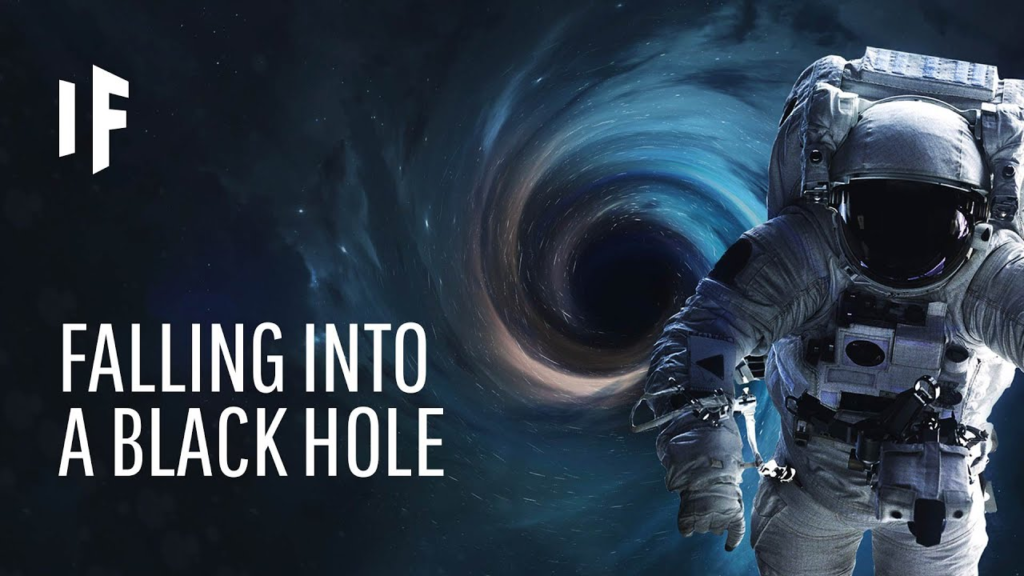
Falling into a black hole is one of the most frightening ideas in space science. It sounds like the final cosmic trap: a place where gravity becomes so powerful that nothing can escape, not even light.
/wp:paragraph
wp:paragraph
But what would actually happen if you fell into a black hole?
/wp:paragraph
wp:paragraph
The answer depends on the type of black hole, its mass, how close you get, and who is watching. From your own point of view, the experience would be very different from what a distant observer would see. You could be stretched by tidal forces, surrounded by distorted light, affected by extreme time dilation, and eventually pulled past a boundary from which no return is possible.
/wp:paragraph
wp:paragraph
That boundary is called the event horizon.
/wp:paragraph
wp:paragraph
NASA explains that black holes are objects with gravity so strong that, beyond a certain region, nothing can escape them. Black holes are often formed when massive stars collapse, creating an object so dense that space and time behave in extreme ways near it.
/wp:paragraph
wp:paragraph
So falling into a black hole would not be like falling into an ordinary hole. It would be falling into a region where gravity, light, time, and space stop behaving the way they do in everyday life.
/wp:paragraph
wp:paragraph
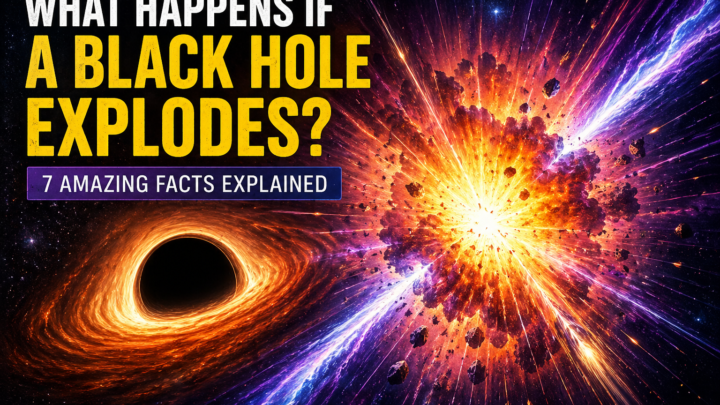
For related space mysteries, you can also read: What Happens If a Black Hole Explodes?
/wp:paragraph
wp:heading
Accuracy note
/wp:heading
wp:paragraph
This article explains what current science says about falling into a black hole. Some parts are well understood through general relativity, including the event horizon, tidal forces, time dilation, and gravitational lensing. Other parts, especially what happens deep inside a black hole, remain unknown because information cannot escape from inside the event horizon.
/wp:paragraph
wp:paragraph
This article does not claim that black holes are portals, wormholes, time machines, or gateways to another universe. Those ideas appear often in science fiction, but they are not confirmed by current observations.
/wp:paragraph
wp:heading
Key Facts About Falling Into a Black Hole
/wp:heading
wp:table
| Key Idea | Simple Meaning | Why It Matters |
|---|---|---|
| Black hole | An object with gravity so strong that nothing can escape within a certain region | It creates the extreme environment |
| Event horizon | The point of no return | After crossing it, escape becomes impossible |
| Spaghettification | Stretching and squeezing caused by extreme tidal forces | This could tear a person, planet, or star apart |
| Time dilation | Time appears to pass differently near strong gravity | A distant observer may see your fall slow down |
| Accretion disk | Hot gas and dust orbiting some black holes | It can glow brightly even though the black hole itself is dark |
| Singularity | A predicted central region where current physics breaks down | Scientists do not yet fully understand it |
| Stellar-mass black hole | A smaller black hole formed from a collapsed star | Tidal forces near it can be deadly before the event horizon |
| Supermassive black hole | A giant black hole found in galaxy centers | You might cross its event horizon before feeling extreme stretching |
/wp:table
wp:heading
What Is a Black Hole?
/wp:heading
wp:paragraph
A black hole is not a giant space vacuum cleaner. It does not randomly suck in everything across the universe.
/wp:paragraph
wp:paragraph
NASA explains that black holes are not cosmic vacuum cleaners. From far enough away, a black hole’s gravity behaves like the gravity of any other object with the same mass. The danger begins when something gets extremely close to it.
/wp:paragraph
wp:paragraph
Example: if the Sun were somehow replaced by a black hole with the same mass, Earth would not instantly be pulled in. Earth would continue orbiting because the gravitational pull at Earth’s distance would be nearly the same. The real danger would be the loss of sunlight, not immediate black hole suction.
/wp:paragraph
wp:paragraph
A black hole becomes extreme because its mass is compressed into a very small region. That allows objects to get very close to a huge amount of gravity. Near that region, normal intuition breaks down.
/wp:paragraph
wp:heading
The Event Horizon: The Point of No Return
/wp:heading
wp:paragraph
The event horizon is the boundary around a black hole where escape becomes impossible.
/wp:paragraph
wp:paragraph
It is not a solid surface. You would not hit a wall. It is an invisible boundary in space-time. But once anything crosses it, no signal, spacecraft, person, or beam of light can return to the outside universe.
/wp:paragraph
wp:paragraph
NASA’s black hole anatomy explanation describes the event horizon as the boundary where the escape velocity exceeds the speed of light. Since nothing can move faster than light, anything inside that boundary is trapped.
/wp:paragraph
wp:paragraph
This is why the event horizon is so important. Outside it, escape may still be possible. Inside it, escape is no longer part of the future.
/wp:paragraph
wp:heading
What Would Happen First?
/wp:heading
wp:paragraph
If you were falling toward a black hole, the first thing you experienced would depend strongly on the black hole’s size.
/wp:paragraph
wp:paragraph
Near a small stellar-mass black hole, the tidal forces would become deadly very quickly. The gravity pulling on the side of your body closer to the black hole would be much stronger than the gravity pulling on the side farther away. This difference would stretch you lengthwise and squeeze you sideways.
/wp:paragraph
wp:paragraph
This process is called spaghettification.
/wp:paragraph
wp:paragraph
NASA describes spaghettification as a real term for matter that gets too close to a black hole. The object is squeezed horizontally and stretched vertically, making it resemble a noodle.
/wp:paragraph
wp:paragraph
Near a supermassive black hole, the situation could be different. Because the event horizon is much larger, the tidal forces at the event horizon may be weaker. In theory, you could cross the event horizon of a supermassive black hole without immediately feeling dramatic stretching.
/wp:paragraph
wp:paragraph
But that would not mean you are safe. Once inside, every possible path leads deeper inward.
/wp:paragraph
wp:heading
Spaghettification: The Most Famous Black Hole Death
/wp:heading
wp:paragraph
Spaghettification happens because of tidal forces.
/wp:paragraph
wp:paragraph
Tidal forces occur when gravity pulls more strongly on one part of an object than another. On Earth, tides happen because the Moon pulls slightly differently on different parts of Earth and its oceans. Near a black hole, this same basic idea becomes extreme.
/wp:paragraph
wp:paragraph
If you fell feet-first toward a black hole, your feet would be closer to the black hole than your head. Your feet would feel a stronger pull. Your body would stretch in the direction of the black hole and compress from the sides.
/wp:paragraph
wp:paragraph
NASA explains that matter near a black hole can be spaghettified, heated, squeezed, pulled apart, and swirled around while time itself behaves in unusual ways.
/wp:paragraph
wp:paragraph
Example: imagine pulling a soft piece of clay from both ends while squeezing it from the sides. Now imagine that process happening with forces so extreme that no biological body could survive it. That is the basic idea of spaghettification.
/wp:paragraph
wp:paragraph
For a person, it would be fatal. For a star, the same process can tear the star apart in what astronomers call a tidal disruption event.
/wp:paragraph
wp:heading
Small Black Hole vs Supermassive Black Hole
/wp:heading
wp:paragraph
Not all black holes would destroy you in exactly the same way.
/wp:paragraph
wp:paragraph
A stellar-mass black hole is formed from a collapsed massive star. It may have several times the mass of the Sun, but its event horizon is relatively small. Because the black hole is compact, tidal forces near it can be incredibly steep. You would likely be torn apart before reaching the event horizon.
/wp:paragraph
wp:paragraph
A supermassive black hole is much larger. These giants can contain millions or billions of times the mass of the Sun and are found in the centers of galaxies.
/wp:paragraph
wp:paragraph
Sagittarius A*, the supermassive black hole at the center of the Milky Way, was imaged by the Event Horizon Telescope, which announced the first direct image of the object in 2022.
/wp:paragraph
wp:paragraph
Near a supermassive black hole, the event horizon is so large that tidal forces at the horizon may be weaker than near a small black hole. You might cross the event horizon first and feel the destructive tidal forces later. But the final outcome would still be unavoidable.
/wp:paragraph
wp:heading
What Would a Distant Observer See?
/wp:heading
wp:paragraph
A distant observer would see something very different from what you experience.
/wp:paragraph
wp:paragraph
From far away, someone watching you fall toward a black hole would see your motion appear to slow as you approached the event horizon. Your light would also become increasingly redshifted, meaning it would stretch toward longer wavelengths and become dimmer.
/wp:paragraph
wp:paragraph
To the distant observer, you would appear to slow down, fade, and nearly freeze near the event horizon.
/wp:paragraph
wp:paragraph
From your own perspective, you would not freeze. You would continue falling.
/wp:paragraph
wp:paragraph
This difference happens because of gravitational time dilation. Strong gravity affects the passage of time. Near a black hole, the effect becomes extreme.
/wp:paragraph
wp:paragraph
Example: imagine two clocks. One clock stays far from the black hole. The other falls closer and closer. To the far-away observer, the falling clock appears to tick more slowly. But for the falling clock itself, time continues normally from its own point of view.
/wp:paragraph
wp:heading
Would Time Stop for You?
/wp:heading
wp:paragraph
No. Time would not stop for you from your own perspective.
/wp:paragraph
wp:paragraph
You would experience your own time normally. Your heartbeat, thoughts, and instruments would continue from your point of view until the environment destroyed you.
/wp:paragraph
wp:paragraph
But to someone watching from far away, your fall would appear to slow down dramatically near the event horizon. This is one of the strangest consequences of relativity.
/wp:paragraph
wp:paragraph
This does not mean you become frozen forever in your own experience. It means different observers describe the event differently.
/wp:paragraph
wp:heading
What Would You See While Falling?
/wp:heading
wp:paragraph
If the black hole had an accretion disk, the view would be spectacular and deadly.
/wp:paragraph
wp:paragraph
An accretion disk is a hot, swirling disk of gas and dust around some black holes. NASA explains that the main light source near a black hole is often the accretion disk, where gas settles into a hot, bright, rapidly spinning disk around the black hole.
/wp:paragraph
wp:paragraph
The black hole’s gravity would bend light around it. You might see stars distorted into rings and arcs. The accretion disk may appear warped because light from the far side is bent around the black hole.
/wp:paragraph
wp:paragraph
This visual distortion is called gravitational lensing.
/wp:paragraph
wp:paragraph
However, the accretion disk would not simply be beautiful. It could be extremely hot and energetic. Radiation near an active black hole could destroy a spacecraft or person long before reaching the event horizon.
/wp:paragraph
wp:heading
Are Black Holes Actually Invisible?
/wp:heading
wp:paragraph
The black hole itself is dark because light cannot escape from inside the event horizon. But black holes can still be detected.
/wp:paragraph
wp:paragraph
Astronomers observe black holes by studying their effects on nearby matter and light. They can detect black holes through accretion disks, X-rays, gravitational lensing, stellar motion, jets, and gravitational waves.
/wp:paragraph
wp:paragraph
The first image of a black hole was released in 2019. NASA explains that scientists using the Event Horizon Telescope obtained an image of the black hole at the center of the galaxy M87, outlined by emission from hot gas swirling around it.
/wp:paragraph
wp:paragraph
That image did not show the inside of the black hole. It showed the black hole’s shadow against glowing material around it.
/wp:paragraph
wp:paragraph
For related telescope content, read: NASA Next-Gen Space Telescopes Tech 2026
/wp:paragraph
wp:heading
What Happens After Crossing the Event Horizon?
/wp:heading
wp:paragraph
Once you cross the event horizon, you cannot send any message back to the outside universe.
/wp:paragraph
wp:paragraph
You could turn on a flashlight, fire a rocket, transmit a radio signal, or launch a probe outward. None of it would escape.
/wp:paragraph
wp:paragraph
Inside the event horizon, space-time is shaped so that all future-directed paths lead deeper inward. In simple words, “out” no longer works the way it does outside the black hole.
/wp:paragraph
wp:paragraph
Eventually, according to classical general relativity, you would approach the singularity.
/wp:paragraph
wp:paragraph
A singularity is often described as a region where density becomes infinite and known physics breaks down. But scientists do not fully understand what truly happens there. NASA notes that after matter falls past the event horizon, we do not yet know exactly what happens, and that part remains a mystery.
/wp:paragraph
wp:heading
Does a Black Hole Lead to Another Universe?
/wp:heading
wp:paragraph
There is no confirmed evidence that black holes lead to another universe, another dimension, or a safe wormhole.
/wp:paragraph
wp:paragraph
Science fiction often uses black holes as portals. That makes great storytelling, but it is not confirmed science.
/wp:paragraph
wp:paragraph
The honest scientific answer is: we do not know everything about what happens inside a black hole, but there is no observational evidence that falling into one would transport you somewhere else.
/wp:paragraph
wp:paragraph
“Unknown” does not mean “portal.” It simply means our current physics cannot fully describe the deepest interior of a black hole.
/wp:paragraph
wp:heading
Could a Spaceship Escape With Enough Power?
/wp:heading
wp:paragraph
Before crossing the event horizon, escape may be possible in theory if the spacecraft has the right path and enough energy.
/wp:paragraph
wp:paragraph
After crossing the event horizon, no.
/wp:paragraph
wp:paragraph
The problem is not just engine power. The event horizon is not a normal barrier that can be beaten with a stronger rocket. It is a boundary where all possible future paths lead inward. Since even light cannot escape, no spacecraft can escape either.
/wp:paragraph
wp:paragraph
Example: a rocket engine works by pushing a spacecraft along a possible path. Inside the event horizon, there is no outward future path that leads back to the external universe.
/wp:paragraph
wp:heading
What If You Fell Into Sagittarius A*?
/wp:heading
wp:paragraph
Sagittarius A* is the supermassive black hole at the center of the Milky Way.
/wp:paragraph
wp:paragraph
If you fell into a supermassive black hole like Sagittarius A*, you might not be instantly destroyed at the event horizon because the tidal forces there can be weaker than around a small black hole.
/wp:paragraph
wp:paragraph
But that does not make the journey survivable. You would still be trapped. You would still move deeper inward. Eventually, the tidal forces would become destructive.
/wp:paragraph
wp:paragraph
The Event Horizon Telescope released the first direct image of Sagittarius A* in 2022, confirming the compact object at the center of our galaxy as a black hole.
/wp:paragraph
wp:heading
What If Earth Fell Into a Black Hole?
/wp:heading
wp:paragraph
If Earth somehow passed too close to a black hole, tidal forces could stretch and tear the planet apart.
/wp:paragraph
wp:paragraph
The side of Earth closer to the black hole would feel a stronger gravitational pull than the far side. Over time, the planet could be deformed, heated, stripped apart, and turned into streams of matter. Some of that material might orbit the black hole in an accretion disk before eventually falling inward.
/wp:paragraph
wp:paragraph
This does not mean black holes roam the universe swallowing planets randomly. Space is enormous, and black holes only become dangerous when objects get extremely close.
/wp:paragraph
wp:heading
Black Holes Are Not Cosmic Vacuum Cleaners
/wp:heading
wp:paragraph
One of the biggest misunderstandings about black holes is the idea that they suck everything in.
/wp:paragraph
wp:paragraph
They do not.
/wp:paragraph
wp:paragraph
A black hole’s gravity depends on its mass and your distance from it. From far away, a black hole does not pull more strongly than any other object with the same mass.
/wp:paragraph
wp:paragraph
The danger is proximity. If you get too close, especially near the event horizon, escape becomes impossible.
/wp:paragraph
wp:paragraph
Example: a planet orbiting far from a black hole could remain in orbit, just as planets orbit stars. The black hole becomes deadly when the planet’s orbit brings it too close.
/wp:paragraph
wp:heading
Why Scientists Cannot See Inside a Black Hole
/wp:heading
wp:paragraph
Scientists can study black holes from the outside, but they cannot directly observe what happens inside the event horizon.
/wp:paragraph
wp:paragraph
The reason is simple: information cannot escape from inside.
/wp:paragraph
wp:paragraph
Astronomers can observe the glowing gas around black holes, the motion of nearby stars, gravitational waves from black hole mergers, and the shadows created by black holes. But once something crosses the event horizon, its information cannot return to outside observers.
/wp:paragraph
wp:paragraph
That is why black holes remain one of the deepest mysteries in physics.
/wp:paragraph
wp:paragraph
For more future telescope-related content, read: NASA Roman Space Telescope 2026
/wp:paragraph
wp:heading
What People Often Get Wrong
/wp:heading
wp:paragraph
Many people think black holes suck in everything nearby. That is false. A black hole’s gravity from far away behaves like the gravity of any object with the same mass.
/wp:paragraph
wp:paragraph
Another mistake is thinking the event horizon is a physical surface. It is not a wall or shell. It is a boundary in space-time.
/wp:paragraph
wp:paragraph
A third mistake is thinking black holes are confirmed portals. They are not. There is no confirmed evidence that falling into one sends you to another universe.
/wp:paragraph
wp:paragraph
A fourth mistake is assuming all black holes destroy you at the same moment. The experience depends strongly on the black hole’s mass.
/wp:paragraph
wp:paragraph
A fifth mistake is thinking scientists can see what happens inside. They cannot. Once something crosses the event horizon, information cannot escape.
/wp:paragraph
wp:heading
Practical Reader Takeaway
/wp:heading
wp:paragraph
If you fell into a black hole, the experience would depend on the black hole’s size.
/wp:paragraph
wp:paragraph
Near a small stellar-mass black hole, you would likely be spaghettified before crossing the event horizon. Near a supermassive black hole, you might cross the event horizon without immediately noticing, but you would still be trapped forever and eventually destroyed by extreme tidal forces.
/wp:paragraph
wp:paragraph
A distant observer would see you slow down, fade, and disappear near the event horizon because of time dilation and redshift. From your own perspective, you would keep falling.
/wp:paragraph
wp:paragraph
The simplest way to understand it is this: falling into a black hole is not like falling into a tunnel. It is falling into a region of space-time where escape stops being possible.
/wp:paragraph
wp:heading
Frequently Asked Questions
/wp:heading
wp:heading
What happens if you fall into a black hole?
/wp:heading
wp:paragraph
If you fall into a black hole, you move toward a region where gravity becomes extremely strong. Depending on the black hole’s size, you may be stretched and squeezed by tidal forces before or after crossing the event horizon. Once you cross the event horizon, escape becomes impossible.
/wp:paragraph
wp:heading
Would you die instantly if you fell into a black hole?
/wp:heading
wp:paragraph
Not always instantly. Near a small stellar-mass black hole, tidal forces could destroy you before you reach the event horizon. Near a supermassive black hole, you might cross the event horizon first, but you would still eventually be destroyed.
/wp:paragraph
wp:heading
What is spaghettification?
/wp:heading
wp:paragraph
Spaghettification is the stretching and squeezing of an object caused by extreme tidal forces near a black hole. NASA describes it as matter being squeezed horizontally and stretched vertically, like a noodle.
/wp:paragraph
wp:heading
What is the event horizon?
/wp:heading
wp:paragraph
The event horizon is the point of no return around a black hole. Inside this boundary, nothing can escape, not even light.
/wp:paragraph
wp:heading
Can light escape a black hole?
/wp:heading
wp:paragraph
Light cannot escape from inside the event horizon. That is why the black hole itself appears dark, even though material around it may glow brightly.
/wp:paragraph
wp:heading
Would time stop if you fell into a black hole?
/wp:heading
wp:paragraph
Time would not stop for you from your own perspective. However, a distant observer would see your fall appear to slow as you approached the event horizon because of gravitational time dilation.
/wp:paragraph
wp:heading
Are black holes wormholes?
/wp:heading
wp:paragraph
There is no confirmed evidence that black holes are wormholes or portals to other universes. That idea appears in science fiction, but it has not been confirmed by observation.
/wp:paragraph
wp:heading
Could you survive falling into a supermassive black hole?
/wp:heading
wp:paragraph
You might theoretically survive the moment of crossing the event horizon of a supermassive black hole because tidal forces there can be weaker than near a small black hole. But deeper inside, the forces would eventually become fatal, and escape would be impossible.
/wp:paragraph
wp:heading
Can scientists see inside a black hole?
/wp:heading
wp:paragraph
No. Scientists cannot directly see inside the event horizon because no information from inside can escape to outside observers.
/wp:paragraph
wp:heading
Has anyone photographed a black hole?
/wp:heading
wp:paragraph
Scientists released the first image of a black hole in 2019 using the Event Horizon Telescope. The image showed the black hole at the center of galaxy M87, outlined by glowing material around it.
/wp:paragraph
wp:heading
Conclusion
/wp:heading
wp:paragraph
Falling into a black hole would be one of the most extreme events imaginable.
/wp:paragraph
wp:paragraph
As you approached, gravity would grow stronger, light would bend, time would behave differently, and tidal forces could stretch and squeeze your body. If the black hole were small, spaghettification could happen before you crossed the event horizon. If it were supermassive, you might cross the event horizon first without immediately feeling anything unusual.
/wp:paragraph
wp:paragraph
But after crossing that boundary, the ending is unavoidable. No signal can escape. No rocket can turn back. No outside observer can see what happens to you directly.
/wp:paragraph
wp:paragraph
The most important point is that black holes are not magical portals or cosmic vacuum cleaners. They are real astrophysical objects where gravity becomes so intense that space-time itself changes the rules of escape.
/wp:paragraph
wp:paragraph
In simple words, if you fall into a black hole, the universe gives you a one-way ticket — and science can only follow you up to the edge.
/wp:paragraph
wp:heading
Sources and Further Reading
/wp:heading
wp:paragraph
NASA Science: Black Holes
https://science.nasa.gov/universe/black-holes/
/wp:paragraph
wp:paragraph
NASA Science: Black Hole Anatomy
https://science.nasa.gov/universe/black-holes/anatomy/
/wp:paragraph
wp:paragraph
NASA Science: What Happens When Something Gets Too Close to a Black Hole?
https://science.nasa.gov/universe/what-happens-when-something-gets-too-close-to-a-black-hole/
/wp:paragraph
wp:paragraph
NASA Science: First Image of a Black Hole
https://science.nasa.gov/resource/first-image-of-a-black-hole/
/wp:paragraph
wp:paragraph
Event Horizon Telescope: First Image of Sagittarius A*
https://eventhorizontelescope.org/blog/astronomers-reveal-first-image-black-hole-heart-our-galaxy
/wp:paragraph
wp:paragraph
Event Horizon Telescope Official Site
https://eventhorizontelescope.org/
/wp:paragraph